Cube Aquarium: Footprint Against Volume by Size
· 12 min read
As an Amazon Associate I earn from qualifying purchases. Built from published specs, hobbyist builds and forum-documented results, with sources named in the text. Links may earn a commission, which has no bearing on what gets recommended.
A cube aquarium trades length for height — and the math shifts at every size
A cube aquarium of 60 cm per side holds roughly four times the water of a standard 60 × 30 × 30 cm rectangular tank, as Practical Fishkeeping notes. The cube's footprint is double. Twice the floor space for four times the volume: that is the case for cubes in one ratio. But the case weakens fast as tanks shrink.
The table below maps footprint against volume for cubes and common rectangles at five lengths, using the industry-standard rectangular proportion of length × half-length × half-length. If you are choosing between shapes for a specific spot on a desk or stand, these numbers show where a cube aquarium earns its extra footprint and where it barely outperforms a rectangle.
Where the geometry pays off
A cube gains volume equally in all three dimensions. A rectangular tank of the same front length gains it mostly in width and height, with depth held to roughly half the length.
At 60 cm, the cube adds 1,800 cm² of footprint and gains 162 litres. At 20 cm, the same proportional trade yields 6 litres for 200 cm². The volume return per square centimetre of floor space roughly triples between nano and mid-size cubes.
On a nightstand, switching a 20 cm tank from rectangle to cube buys 6 litres. That barely changes stocking options. At 40 cm the picture shifts: 48 extra litres opens real planted tank possibilities. Past 60 cm, the cube becomes a different category entirely, crossing 200 litres (44 gallons) in a footprint that fits a standard 60 cm stand.
The basis for this list: published product information and manufacturer figures only. Nothing here was measured or used in person. The short version
- The pick: LANDEN 25C — a hobbyist who wants a premium-glass nano for a planted shrimp tank or a minimalist desktop aquascape without paying for capacity they don't need.
- Also worth it: Yobiisolut — a parent or hobbyist who wants a tiny, stackable display for sea monkeys, moss balls, or a single shrimp — not a serious fish habitat.
- How this was decided: published specifications and buyer reports across 9 products, compared below.
How much weight does a cube put on your floor?
Volume stacks vertically. Weight follows it.
A cube concentrates more mass per unit of floor than a rectangular tank holding the same water, because it piles volume onto a smaller base. The difference is large enough to matter structurally, especially in apartments with standard wood-frame construction.
Here is what each common cube size loads onto the floor, based on calculated water weight (1 kg per litre), estimated glass weight, and a conservative 5 kg of substrate and hardscape for tanks above 25 cm. Practical Fishkeeping notes that even the empty 60 cm cube was heavy enough that its reviewer could barely lift it onto the cabinet alone.
| Cube size | Filled weight (approx.) | Footprint | Load (kg/m²) |
|---|---|---|---|
| 20 cm | 10 kg | 0.04 m² | 250 |
| 25 cm | 19 kg | 0.0625 m² | 304 |
| 40 cm | 75 kg | 0.16 m² | 469 |
| 60 cm | 235 kg | 0.36 m² | 653 |
These per-square-metre figures are high relative to typical residential floor ratings. In practice, small tanks sit on furniture that spreads the load across a wider area, so a 20 cm nano on a desk is not a concern. The 40 cm cube is where real caution starts: 75 kg on 0.16 m² means the stand's footprint determines whether you stay within structural limits.
A 60 cm cube filled to the rim loads approximately 653 kg/m² over its own footprint. Placing one against a load-bearing wall or over a floor joist, rather than mid-span, is prudent. No ranking result for "cube aquarium" mentions floor-load considerations, yet it is among the first constraints an apartment fishkeeper should check with their building management.
The 45 cm reach line and what it costs you
Every cube aquarium in this roundup shorter than 40 cm stays below the 45 cm line. That matters more than aesthetics.
A cube taller than about 45 cm (18 inches) generally forces you to submerge past the elbow to touch substrate. Below that height, you can plant, reposition stone, and siphon debris with bare hands and a short gravel vacuum. Above it, you need 60 cm planting tweezers, extended scrapers, and a willingness to roll your sleeve past the bicep. Practical Fishkeeping flags the difficulty of filling vertical space with plants and hardscape in cubes but stops short of naming the measurement where maintenance comfort breaks down.
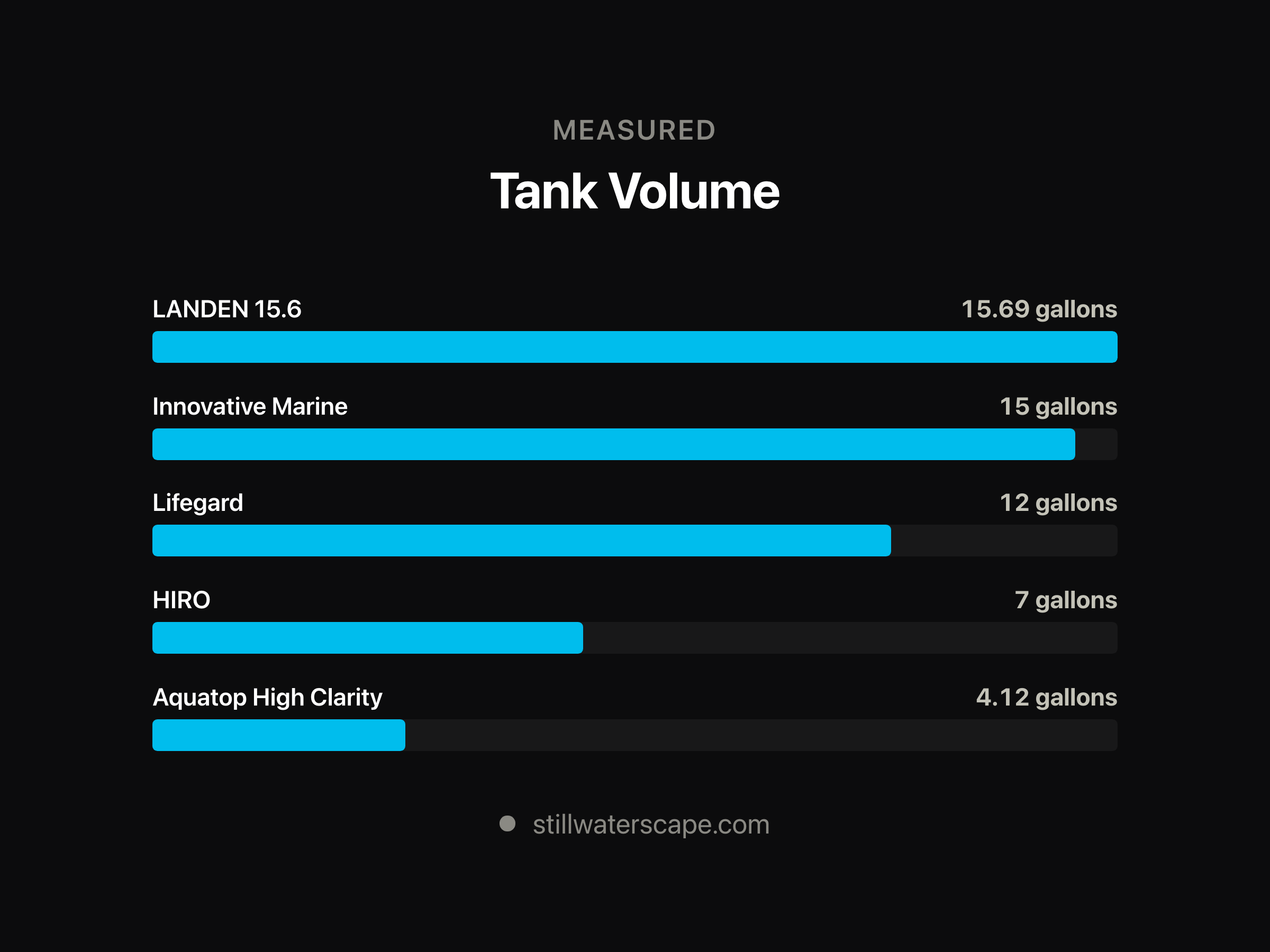
The LANDEN 25C sits at 25 cm tall. The Aquatop cube reaches 9.84 inches (25 cm). Both keep your hand well above the elbow. The LANDEN 40 cm cube hits exactly 40 cm, still under the threshold. The Innovative Marine 15 Gallon Cube at 15 inches (38 cm interior height once you subtract the rear filtration wall) also clears it.
Jump to a 60 cm cube and the picture changes entirely. At 60 cm you are shoulder-deep. Gravel vacuuming becomes a two-tool job: one hand holds the siphon, the other guides it with long forceps. None of the nine tanks here reach that size, which means every option on this list falls on the comfortable side of the reach line.
The practical upshot: cube height only becomes a maintenance penalty when you move beyond the 40 cm format. Within it, the shape is no harder to service than a rectangular tank of the same capacity.
| Product | Product Dimensions | Material | Item Weight | Additional Features | Suits |
|---|---|---|---|---|---|
| Yobiisolut | 6"L x 4"W x 5"H | Acrylic | 0.51 kg | Stackable, Transparent | Best micro display |
| 2 Gallon Clear | 7.87"L x 7.87"W x 7.87"H | Low Iron Glass | — | Rimless | Best ultra-compact |
| Tetra | 10.31"L x 11.06"W x 17.5"H | Plastic | 2 kg | Lightweight | Best starter kit |
| LANDEN 25C | — | Glass | 5.5 pounds | Rimless | Best small rimless |
| Aquatop High Clarity | 9.84"L x 9.84"W x 9.84"H | Glass | 6 pounds | Easy to Clean, Easy to Use | Best pico reef candidate |
| HIRO | — | Extra Clear Glass | — | Lightweight, Rimless | Best dual-use |
| Lifegard | 14.52"L x 14.52"W x 14.52"H | Glass | 36 pounds | Rimless, Ultra Clear Glass | Best mid-size |
| LANDEN 15.6 | 15.7"L x 15.7"W x 15.7"H | Glass | 11.79 kg | Rimless | Best aquascaping standard |
| Innovative Marine | 15"L x 15"W x 15"H | Glass | 36 pounds | All in one built in filtration | Best all-in-one |
Spec columns quote the listings verbatim. “Suits” is editorial.
Sort it in ten seconds
- Yobiisolut — not for you if this matters: at 0.6 gallons and 6 × 4 × 5 inches it cannot humanely house any fish beyond perhaps a few brine shrimp.
- 2 Gallon Clear — not for you if this matters: 2 gallons is marginal even for a betta and rules out most community setups.
- Tetra — not for you if this matters: acrylic yellows and scratches over time compared with glass.
Why dead spots form in equal-sided tanks
Rectangular tanks have a long axis. Water exits the return, travels the length, hits the far glass, and loops back — a single dominant current path. A cube has no long axis. All three dimensions are nearly equal, so the return jet hits the opposite wall at roughly the same distance in every direction. In practice, this can cause flow to split, curl, and stall in the diagonal corners where opposing currents meet.
Those dead spots can collect detritus and reduce oxygen exchange in the corners. In a 25 cm cube the effect is mild because the volume is small enough for diffusion to compensate. In a 40 cm cube it becomes more noticeable.
A common fix is to angle the return nozzle toward the opposite corner rather than straight across, encouraging a circular flow path that sweeps all four walls before returning to the intake. The Aquatop cube ships with dual-directional flow nozzles, which makes aiming easier than with a fixed outlet. A marine shop professional writing for AlgaeBarn notes that fish like tangs, wrasses, and anthias need swim length and depth more than height; in a cube, a working circular flow at least keeps the water they do have moving rather than stagnant.
Island or triangle aquascapes help too. Practical Fishkeeping recommends them for cubes viewed from multiple sides, and they also leave open channels along the glass where flow can circulate instead of hitting a wall of stone.
Nine cube aquariums compared: specs, glass, and what ships in the box
Specs tell one story. Glass tells another.
Seven of these nine tanks use low-iron glass. The remaining two, the Yobiisolut 0.6 gallon and the Tetra Cube 3 gallon, are acrylic. That split determines clarity, scratch resistance, and how the tank ages. Low-iron glass transmits around 91% of light according to LANDEN's published specs; Lifegard Aquatics claims 92% for its 12 gallon cube. Rimless sellers emphasise low-iron glass as a distinguishing feature, and it is a different material from the standard float glass used in rimmed cubes.
What ships with each tank
Most cube aquariums arrive empty. The exceptions matter.
- Innovative Marine 15 Gallon Cube: integrated rear filtration chamber with acrylic overflow wall, removable 200-micron filter sock, and adjustable 130 GPH DC return pump. The only tank here with built-in mechanical and biological filtration.
- Tetra Cube 3 Gallon: air-pump-driven Whisper filter, LED light strip, clear feeding canopy, and decorative pedestal base. The only kit that includes lighting.
- Aquatop 4.12 Gallon Cube: flexible hose, return elbows, and dual-directional flow nozzles. No pump or filter, but the plumbing fittings are unusual at this size.
- Yobiisolut 0.6 Gallon: ships with aquarium gravel, resin figures, a mini fence, and a plastic tree. No filtration, no light. At 6 × 4 × 5 inches it is rectangular, not cubic, despite the listing's language.
- LANDEN 25C (3.7 Gallon): tank and nano foam leveling mat only. German-silicone seams, 5 mm glass, mirror-polished chamfered edges.
- LANDEN 40 cm Cube (15.6 Gallon): same construction as the 25C but steps up to 6 mm glass at 40 × 40 × 40 cm. Leveling mat included. Nothing else.
- Aqua Worx 2 Gallon: low-iron glass, leveling mat, true 7.87-inch cube. Glass thickness is not listed on the product page.
- HIRO AQUATICS 7 Gallon: extra-clear low-iron glass with two lid configurations, one partial-coverage for filter hoses and one full-coverage for 100% humidity terrarium use. White leveling mat included.
- Lifegard 12 Gallon Cube: 5 mm ultra-low-iron glass at 14.52 × 14.52 × 14.52 inches. Listed at 36 pounds empty, which seems high for this volume and may include packaging.
Glass thickness and where it shifts
Every tank from 2 to 12 gallons in this group uses 5 mm glass. Only the LANDEN 40 cm cube moves to 6 mm, and the Innovative Marine 15 gallon also uses 6 mm. That 5 mm threshold holds across brands, but 12 gallons at 5 mm sits at the boundary: most manufacturers step to 6 mm somewhere between 10 and 15 gallons. The Lifegard 12 gallon stays at 5 mm, which is adequate but not generous for a tank that holds roughly 100 pounds of water when filled.
Five of nine tanks include a leveling mat. If yours does not, buy one separately. Uneven pressure on rimless glass cracks panels.
Which cube fits which keeper
Footprint decides it.
A desktop shrimp colony needs the smallest glass cube that still holds stable parameters. The LANDEN 25C at 9.84 × 9.84 inches occupies less space than a sheet of printer paper; its 3.7 gallons and 5 mm low-iron glass give shrimp enough volume without dominating a desk. For a single betta on a nightstand, the Aqua Worx 2 Gallon fits inside an 8-inch square, though 2 gallons is marginal and demands more frequent water changes than most beginners expect.
When the cube grows past the desk
First-time fishkeepers who want everything in one box should look at the Tetra Cube 3 Gallon. Filter, light, and canopy ship together. The trade-off is acrylic instead of glass and a pedestal that pushes total height to 17.5 inches.
Planted aquascapes land on the LANDEN 40 cm cube. The 40 × 40 × 40 cm format is a popular choice for aquascaping, and its 6 mm glass handles the roughly 130 pounds of filled weight without concern. That 15.7-inch square footprint is twice what a 60 × 30 cm rectangular tank would claim, exactly the ratio from the opening comparison. You get four times the volume for double the floor space.
Pico reef keepers face a harder call. A marine shop professional writing for AlgaeBarn recommends a minimum of 30 gallons for beginners because parameter swings punish small volumes. The Innovative Marine 15 Gallon Cube is the only tank here with integrated filtration, but its display area shrinks to roughly 11 gallons once the rear chamber is accounted for. Experienced reef hobbyists can manage that. Beginners probably cannot.
A keeper who wants the option of converting to a paludarium later should consider the HIRO AQUATICS 7 Gallon, whose full-coverage lid maintains 100% humidity for terrestrial setups.
The ratio from the top of this article holds at every size: cubes claim about twice the footprint of a same-length rectangular tank and return roughly four times the water. Whether that exchange is worth it depends on one measurement: how many square inches your surface can spare.
Which one, then?
LANDEN 25C — best for a hobbyist who wants a premium-glass nano for a planted shrimp tank or a minimalist desktop aquascape without paying for capacity they don't need.
If your case is different:
- For a parent or hobbyist who wants a tiny, stackable display for sea monkeys, moss balls, or a single shrimp — not a serious fish habitat — Yobiisolut.
- For someone who wants the smallest proper rimless glass cube that can hold a single betta or a shrimp colony on a tight desktop — 2 Gallon Clear.
- For a first-time fishkeeper who wants to unbox one product and have a running tank the same evening — filter, light, and canopy included — Tetra.
The LANDEN 25C’s weak spot: tank only — no filter, light, or lid included
Questions
How big is a 60 cm cube aquarium?
A 60 cm cube aquarium measures 60 × 60 × 60 cm, occupies 3,600 cm² of floor space, and holds approximately 216 litres (about 57 US gallons). Filled with water, substrate, and hardscape it weighs roughly 235 kg and loads about 653 kg per square metre over its own footprint, so placement over a floor joist or against a load-bearing wall is recommended.
Are cube aquariums harder to maintain than rectangular tanks?
Cube aquariums under about 40 cm tall are no harder to maintain than rectangles of similar capacity because your hand stays above elbow depth. Above 45 cm, you need long planting tweezers, extended scrapers, and deeper arm immersion. Cubes can also develop flow dead spots in diagonal corners, though angling the return nozzle toward the opposite corner usually fixes this.
How much does a cube aquarium weigh per square foot of floor space?
A filled 20 cm cube loads about 250 kg per square metre, a 40 cm cube roughly 469 kg/m², and a 60 cm cube approximately 653 kg/m². These figures exceed typical residential floor ratings, so cubes above 40 cm should sit on stands that spread weight across a wider area, ideally positioned over joists or near load-bearing walls.
Sources
- Cube Rimless Glass Aquariums accessed 2026-08-02
- How to set up a low maintenance cube-shaped aquarium - Practical Fishkeeping accessed 2026-08-02
- Tank Buying Tips from a Pro | Beginners Education | AlgaeBarn accessed 2026-08-02
- Rimless Aquarium Buying Guide for Aquascapers accessed 2026-08-02