Aquarium Water Change Volume: Hose Reach vs Buckets
· 14 min read
As an Amazon Associate I earn from qualifying purchases. Built from published specs, hobbyist builds and forum-documented results, with sources named in the text. Links may earn a commission, which has no bearing on what gets recommended.
The weekly change
A 40 gallon breeder, a 5 gallon bucket, and a bathroom two rooms away. That is eight round trips for a 50 percent change, four for 25 percent.
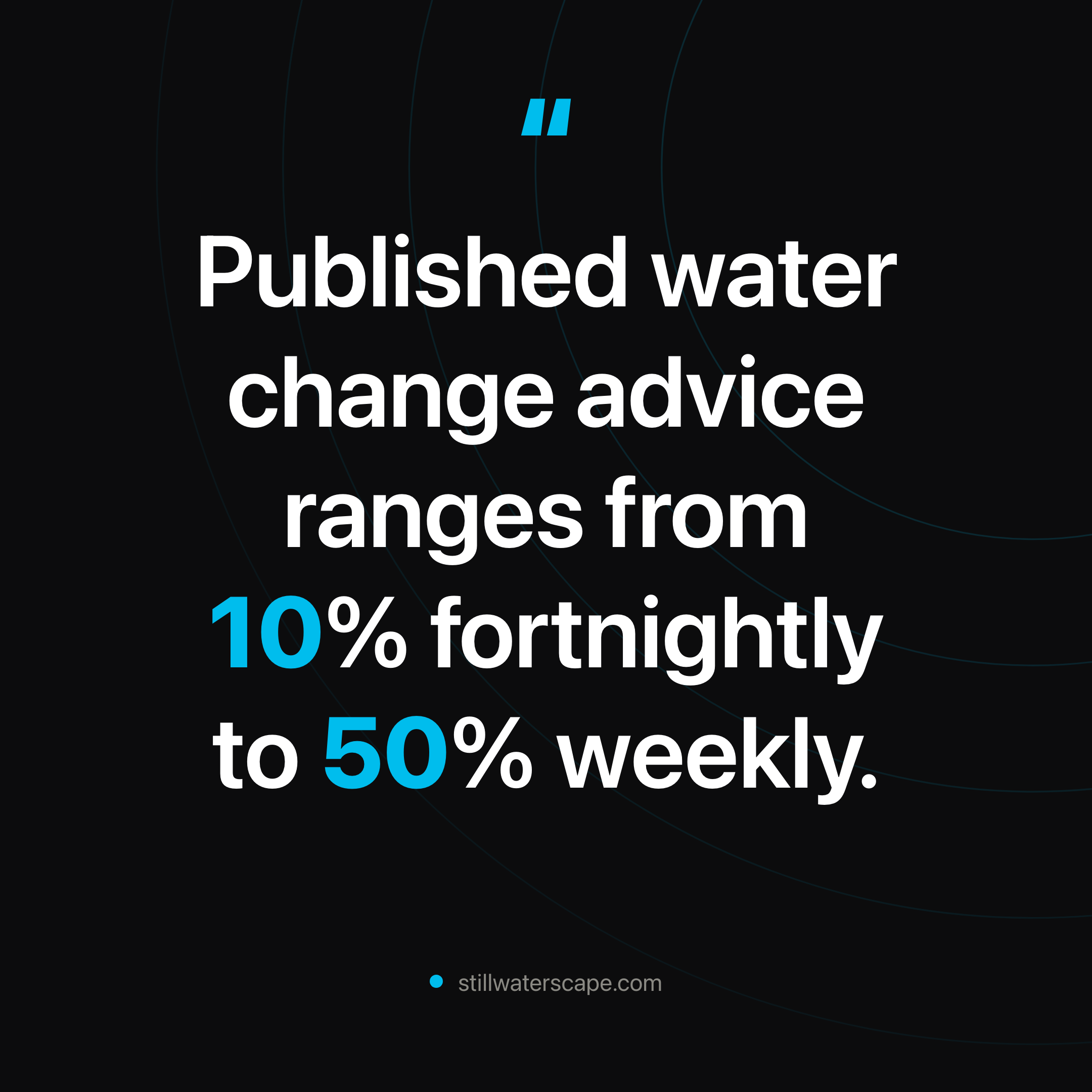
The published advice does not help you resolve this. Algagen puts the mainstream baseline at 10–25 percent every one to two weeks, and warns against exceeding 50 percent in a single change outside emergencies.
So work it backwards. This piece treats volume as logistics: how far your hose reaches, how many buckets you will genuinely carry, and which of the conflicting percentages that leaves available to you. Owners running a Python on tanks up to 55 gallons report a full change in about 15 minutes, dropping to roughly 10 minutes weekly once the routine is set.
The short version
- The pick: Python No Spill Clean, for you want to move large water change volumes on a tank sited within about 25 feet of a faucet, without carrying a single bucket.
- Also worth it: lopeztek, for you are refilling a small tank by bucket or jug and want the poured volume to land without blasting the substrate out of place.
- How this was decided: published specifications and buyer reports across 9 products, compared below.
Bucket trips per change: 5 to 125 gallons
A 25 percent change on a 40-gallon tank is 10 gallons of water. That is two trips with a 5-gallon bucket, or four with a 3-gallon one, and then the same again to carry the replacement back. The number that matters is not the percentage, it is the round trips.
Here is the arithmetic, rounded up, because you cannot carry two thirds of a bucket:
- 10 gallons removed (25 percent of 40G, or 20 percent of 50G): 2 trips at 5 gallons, 4 at 3 gallons. Double for drain plus refill.
- A 20-gallon change on a 75G or 80G tank: 4 trips at 5 gallons, 7 at 3 gallons; 8 and 14 respectively with the refill.
- 50 percent of a 125G: about 63 gallons. 13 trips at 5 gallons each way. Nobody does this weekly by hand.
At the small end the numbers stay trivial. A 50 percent change on a 5-gallon nano is half a bucket. A 10 percent change on a 20G is 2 gallons, which is a jug.
On Reefs.com, one 120-gallon owner describes doing 10 percent every other week in about five minutes; the interval is doing the work there, not the volume. Another keeper with 160 gallons moves about 20 gallons every two to three weeks using two 20-gallon tubs, which is a cart job, not a bucket job.
Above a certain size the hose stops being optional, though no source sets that threshold. Above that the Python No Spill Clean and Fill system stops being a convenience and starts being the reason the change happens at all.
Your denominator is wrong before you start
A 40 gallon tank labelled 40 gallons does not hold 40 gallons of water. It holds the rating minus substrate, minus rock, minus the two inches of freeboard you leave below the rim. On a planted or scaped tank that shortfall can be substantial. Every percentage instruction you have ever read uses the label as its denominator.
Work the actual figure instead. Bulk Reef Supply's volume calculator converts tank dimensions at 7.48 US gallons per cubic foot and counts only the filled portion: the water, not the box. Then subtract displacement. Then subtract whatever substrate and rock displace. No published source in this set bridges dimensional volume to the real water volume of a stocked tank.
The point stands even without figures: pull a clean "50 percent" by the label and the fraction of actual water you changed is smaller, by however much substrate, hardscape and freeboard take up.
The filter intake sets the floor. You cannot drain below it without the canister sucking air, and on many setups that strainer sits some way off the substrate. Measure to it once. That depth, not the rated volume, is the largest change your plumbing permits.
Why 30 percent is not three times better than 10
Consider a tank that produces 5 ppm of nitrate a week, a hypothetical figure, since no source in this set gives a nitrate production rate or target. Change 10 percent weekly and nitrate settles near 50 ppm. Change 30 percent weekly and it settles near 17. That is the whole argument about volume, and almost nobody runs it.
The arithmetic is a geometric series, not a subtraction. Each week you add production, then remove a fraction of everything present. Equilibrium sits at weekly production divided by the fraction you remove. Ten percent gives 1/0.1, so ten times weekly production. Thirty percent gives 1/0.3, so a bit over three times. Fifty percent gives twice weekly production.
Three plateaus, same 5 ppm per week:
- 10% weekly → ~50 ppm
- 30% weekly → ~17 ppm
- 50% weekly → ~10 ppm
Look at the gaps. Going from 10 to 30 percent removes about 33 ppm. Going from 30 to 50 percent removes about 7. You tripled the volume for the first step and cut equilibrium nitrate by roughly two-thirds. The second step costs you another 8 gallons out and 8 gallons back on that 40 gallon tank, and buys you a fifth of what the first one did.
This is why the published disagreement matters less than it looks. Algagen puts the mainstream baseline at 10–25 percent every one to two weeks. Buce Plant calls for 30–50 percent weekly on larger tanks with substantial livestock, roughly double, and attributes algae in aquascapes to changes done too infrequently. No source explains what drives the difference between the two figures; the dilution arithmetic above is one possible reading, not a published one.
Buce Plant does say volume and frequency should be set by the tank's bioload, which rises with the amount of livestock; no source in this set ties a feeding rate to a resulting plateau.
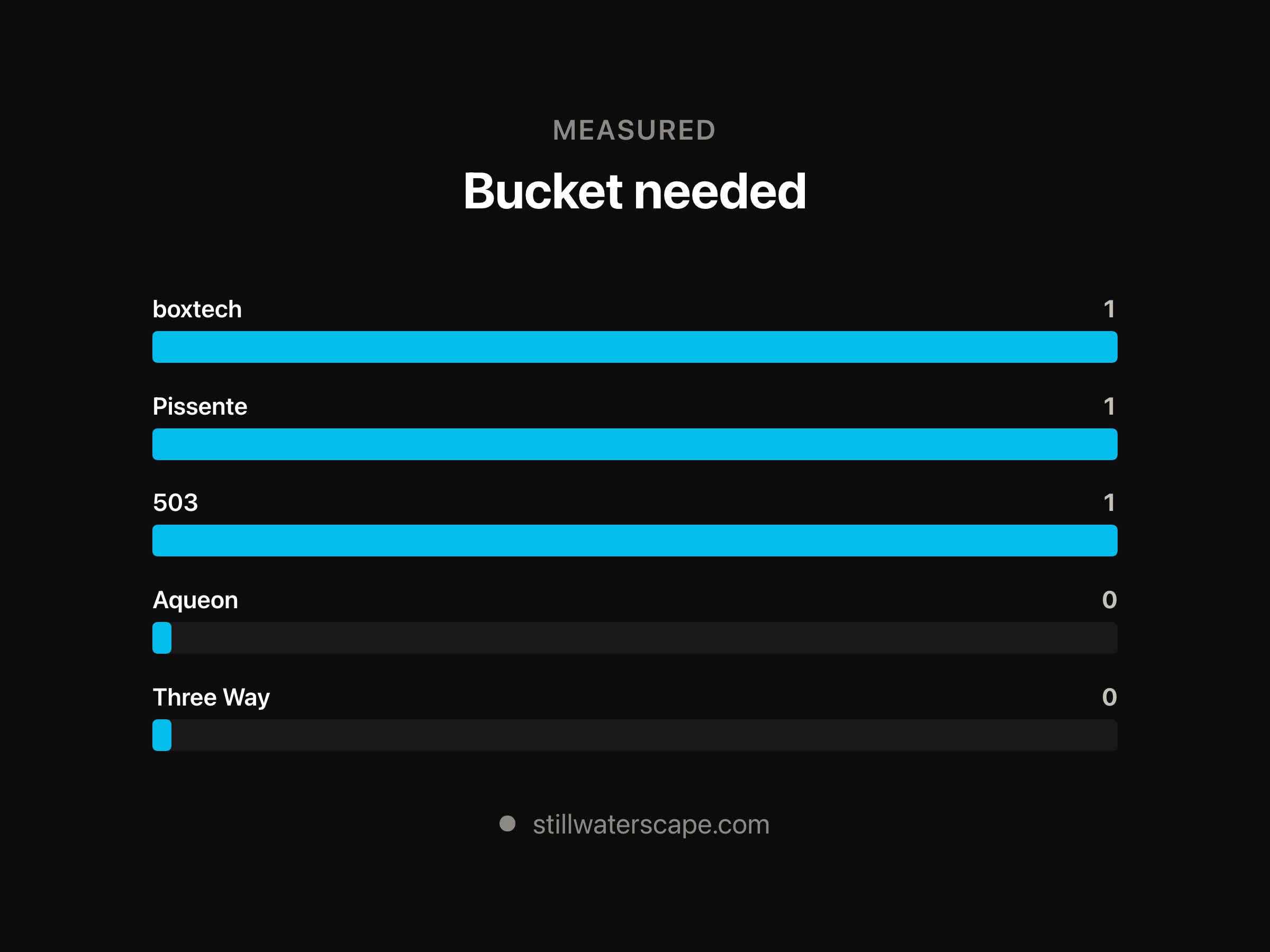
| Product | Material | Bucket needed | Suits |
|---|---|---|---|
| Python No Spill Clean | Plastic, Vinyl | — | Best hose reach |
| lopeztek | — | — | Best for bucket refills |
| Seachem Prime Fresh | — | — | Best volume dosing |
| Aqueon | Cotton | 0 | Best flow control |
| boxtech | BPA-free plastic and flexible tubing | 1 | Best budget siphon |
| Pissente | Plastic | 1 | Best all-in-one kit |
| Three Way | Plastic | 0 | Best drain/fill diverter |
| mkiqvix | Plastic | 0 | Best for sand tanks |
| 503 | Plastic and PVC hose | 1 | Best mid-length hose |
Spec columns quote the listings verbatim. “Suits” is editorial.
Sort it in ten seconds
- Python No Spill Clean, not for you if this matters: tied to a faucet — the tank has to be within 25 feet of one, and further rooms need added hose.
- lopeztek, not for you if this matters: controls how water enters, not how much — you still count buckets yourself.
- Seachem Prime Fresh, not for you if this matters: a treatment, not a tool — moves no water and measures no volume on its own.
Weekly 50 percent versus 50 gallons every six months
Buce Plant's 30–50 percent weekly and the reefer who moves 50 gallons on a 176 gallon system every few months sit at opposite ends of the same set of recommendations. No source reconciles them. One plausible reading, unsupported by anything in these pages, is that the weekly figure is an export rate set against a heavy import rate, while the six-month figure belongs to a system where import is handled elsewhere by skimming, refugium or dosing, so the change exists to restore trace elements rather than to strip nitrate.
Buce Plant also publishes 15–20 percent weekly for lightly stocked tanks with strong filtration, or 20 percent bi-weekly, and AlgaGen puts lightly stocked or heavily planted tanks as low as 10–15 percent every two weeks. Whether these describe tanks at different points on an import curve is not something any of these sources says. The reef end of the range is wider still: one reefer on that reefs.com thread runs 15–18 gallons a week on a 130 gallon system, about 12–14 percent; another changes 45 gallons four times a year; a third changes three gallons every single day on an automatic system; and Reef Moonshiners participants do no changes at all, dosing against ATI-ICP results instead.
The two-week test
Stop guessing from stocking. Do a change, record nitrate the same day, then record it again fourteen days later with no change in between.
- A small rise suggests import is already handled elsewhere, and the change is doing mineral replacement rather than nitrate control.
- A moderate rise puts you in the middle of the published range.
- A large rise is where the higher-volume weekly figures start to look less excessive.
The thresholds are yours to set: no source in this set gives a nitrate target that a given change volume is meant to achieve.
The reading costs one test kit and two weeks. It settles what a hundred forum posts cannot.
Rate of change
A 20 gallon tank at 78°F, refilled with 10 gallons of tap water at 68°F, lands at roughly 73°F. That is a 5°F drop in the time it takes the hose to run. The same 68°F water at a 10 percent change moves the tank by about 1°F. Whether fish notice a shift that small is not something any source here addresses.
The arithmetic
Temperature shift equals the mismatch multiplied by the fraction replaced. At 10 percent, a 10°F error costs you 1°F. At 25 percent it costs 2.5°F. At 50 percent it costs 5°F, which is where Buce Plant's 5-degree warning and Aqua Logic HQ's 2°F tolerance start to bite.
Buce Plant warns that even a 5-degree difference between tank and replacement water could shock livestock. Aqua Logic HQ sets a tighter tolerance: refill within 2°F of the tank. Both are stated flatly, and neither source says whether the tolerance applies to the bucket or to the tank's final temperature. Read as a limit on the tank's final shift, they would imply the following slack against Buce Plant's limit:
- 10 percent change: you can be 20°F off.
- 25 percent change: roughly 8°F.
- 50 percent change: about 4°F.
That reinterpretation is the author's, not the sources'.
What actually makes 70 percent safe
No source in this set identifies which parameter shift causes the shock a large change is said to risk. No source here supports large changes as routine: AlgaGen discourages changing more than 50 percent at once outside emergencies, because a large swing can shock fish. Algagen's drip method — prepared water through airline tubing and a valve over several hours — exists for exactly the cases where the swing itself is the hazard: fry, shrimp, sensitive fish.
Nothing in these sources addresses old-tank syndrome, nitrate thresholds, or the pH and TDS swing a change produces in a long-neglected tank, so that risk cannot be quantified from them.
Nine tools
The sourced tools split on a few criteria: how far they reach, how many bucket trips they leave you, and whether they cover the drain half or the refill half. None of what follows comes from my using them. It comes from the manufacturers' listings and published figures, which is a weaker basis than measurement and worth saying out loud.
Reach first. Bulk Reef Supply notes the Python No-Spill system comes in 25, 50, 75 or 100 foot tubing lengths and adapts to any standard faucet. That covers the 40-gallon-and-up problem from the previous section. Both are faucet-driven, which means both share the same failure: Aqua Logic HQ points out the tap has to run for the entire change, so you waste tap water to move tank water. The same review warns that the plastic faucet adapter in Python-style kits will strip faucet threads within a month, and suggests budgeting about $15 more for a brass one.
Python No Spill Clean — Best hose reach
- 25 feet of vinyl hose covers the run from most tanks to a kitchen or bathroom faucet
- Drains and refills through the same line, so no bucket count at all
- But: Tied to a faucet — the tank has to be within 25 feet of one, and further rooms need added hose
- But: Faucet pump wastes tap water while it runs the siphon
lopeztek — Best for bucket refills
- Physically breaks a pouring stream and spreads it sideways, so gravel and sand stay where they were
- ABS construction rated aquarium-safe
- But: Controls how water enters, not how much — you still count buckets yourself
- But: Does nothing for the drain half of the water change
Seachem Prime Fresh — Best volume dosing
- One 5 mL capful treats 200 L (50 US gallons), so dosing maps directly onto your change volume
- Drops down to 2 drops per gallon for small buckets and betta tanks
- But: A treatment, not a tool — moves no water and measures no volume on its own
- But: Requires you to know your change volume accurately before dosing
Aqueon — Best flow control
- Flow control valve on the handle lets you stop mid-change without running to the tap
- Slimmer gravel tube suits smaller and planted tanks
- But: Narrower tube siphons more slowly on deep gravel beds
- But: Plastic threaded collar can leak if overtightened
boxtech — Best budget siphon
- Hand pump primes the siphon without mouth-starting or shaking
- Short hose is easy to rinse and dry between changes
- But: Every litre removed still has to be carried in a bucket
- But: 6.5 ft hose barely clears a tall stand to a floor bucket
Pissente — Best all-in-one kit
- Multi-piece kit adds a scraper and net attachments to one handle
- Longer hose than most starter siphons
- But: Accessory heads add clutter and more parts to lose
- But: Bucket-only drain, no refill path
Three Way — Best drain/fill diverter
- Switches a single hose run between drain and refill without unhooking anything
- Lets a pump-fed system reuse one hose for both directions
- But: Valve only, no hose or pump included
- But: Plastic barbs need clamps under pump pressure
mkiqvix — Best for sand tanks
- Spreads incoming water so a 50 percent refill does not dig craters in sand
- Protects delicate plants and shrimp during fast fills
- But: Only useful on the refill half of the job
- But: Large size is awkward in a nano tank
503 — Best mid-length hose
- 10 ft hose reaches a floor drain or tub from many stands
- Pump bulb starts the siphon on the first squeeze
- But: Still bucket-dependent for refill
- But: PVC hose holds coil memory and kinks
The half-finished change, and who should pick what
The change that goes wrong is rarely the one you finish. It is the one you abandon at trip five: the hose two feet short of the bathroom, the bucket tipped on the hallway floor, the replacement water still short of tank temperature because BucePlant notes that getting replacement water to matching parameters can take up to 24 hours. Halfway is a real state, and it has a safe version. Aqualogic HQ warns that heaters and filter pumps must be unplugged before draining, because a heater element that runs dry and is then hit with cool refill water can fracture instantly. What the sources do warn against is running tap water in without conditioner. Add the conditioner to the tank first, as Algagen recommends for tap-fed systems, then refill slowly.
So, matched to the constraint rather than ranked:
- Tank within reach of a faucet, high volume, zero buckets: the Python No-Spill Clean & Fill, sold in 25 to 100 foot lengths at $50 to $130 and rated 4.5 stars across 8,091 reviews.
- Draining to the last half-inch without losing prime: the Hygger Bottom Intake pump, $19.99 for the 215 GPH model to $38.99 for the 1060 GPH, rated 4.3 stars across 2,013 reviews.
- Emptying a flat-bottom mixing container completely: the Sicce Ultra Zero, which works in as little as 2mm of water and pushes up to 790 GPH.
- Automating small, frequent changes on a smaller tank: the Auto Aqua Smart Auto Water Changer Duo, which uses optical sensors and bundles an ATO.
The 40 gallon breeder with the bathroom two rooms away? Buy the 25 feet of hose, not the resolve. Eight trips becomes none, and the 50 percent you planned stops being theoretical. Then watch your nitrate for a month and see whether you ever needed 50 percent at all.
Which one, then?
Python No Spill Clean, best for you want to move large water change volumes on a tank sited within about 25 feet of a faucet, without carrying a single bucket.
If your case is different:
- For you are refilling a small tank by bucket or jug and want the poured volume to land without blasting the substrate out of place: lopeztek.
- For you are dosing replacement water by the gallon and need a conditioner whose measurement scales cleanly from a two-drop jug to a fifty-gallon refill: Seachem Prime Fresh.
- For you want tap-driven changes but need to throttle or halt the siphon at the tank end while working around plants: Aqueon.
The Python No Spill Clean’s weak spot: tied to a faucet — the tank has to be within 25 feet of one, and further rooms need added hose
Questions
How many buckets is a 25% water change?
On a 40-gallon tank, 25% is 10 gallons: two trips with a 5-gallon bucket or four with a 3-gallon one, then the same again to carry replacement water back. Count round trips rather than percentages. A 20-gallon change on a 75G tank is eight bucket trips in total.
Can I do a 50% water change in my fish tank?
Yes, but AlgaGen discourages exceeding 50% in a single change outside emergencies, since a large parameter swing can shock fish. Physically, 50% of a 125-gallon tank is roughly 63 gallons, or 13 bucket trips each way — which is why large tanks need a hose rather than resolve.
How do I work out the volume of water in my fish tank?
Use dimensions, not the label. Bulk Reef Supply's calculator converts tank dimensions at 7.48 US gallons per cubic foot, counting only the filled portion. Then subtract substrate, rock and the freeboard below the rim. A tank sold as 40 gallons holds noticeably less actual water.
Is a 10% weekly water change enough with a filter?
It depends on your nitrate production. Equilibrium nitrate equals weekly production divided by the fraction removed, so 10% weekly settles at ten times weekly production — around 50 ppm on a tank making 5 ppm a week. Thirty percent weekly settles near 17 ppm instead.
How long should a water change take?
Owners running a Python system on tanks up to 55 gallons report about 15 minutes for a full change, dropping to roughly 10 minutes once the routine is set. One 120-gallon keeper doing 10% every other week finishes in about five minutes. Bucket-only routines take considerably longer.
Why do some reef keepers change water only every few months?
On systems where nitrate import is handled by skimming, refugium or dosing, the change restores trace elements rather than stripping nitrate. One keeper moves 45 gallons four times a year; Reef Moonshiners participants do no changes at all, dosing against ATI-ICP test results instead. No source formally reconciles these approaches.
Sources
- TOP TIPS - Aquarium Water Change Recommendations accessed 2026-08-04
- The Best Methods for Aquarium Water Changes accessed 2026-08-04
- Best Aquarium Water Change Tools - Bulk Reef Supply accessed 2026-08-04
- Aquarium Water Volume Calculator - Bulk Reef Supply accessed 2026-08-04
- How to Do a Water Change (& Why It's Important!) accessed 2026-08-04
- Best Aquarium Water Change Pumps: My Top Picks for 2026 accessed 2026-08-04