Aquarium Stand Weight Capacity: How Much Can It Hold?
· 12 min read
As an Amazon Associate I earn from qualifying purchases. Built from published specs, hobbyist builds and forum-documented results, with sources named in the text. Links may earn a commission, which has no bearing on what gets recommended.
A 55-gallon at 600 pounds, 625 pounds, or neither
Two spec sheets, one 55-gallon tank, a 25-pound gap. TankZen's loaded-weight table puts a filled 55 at about 600 lbs; AQQA, working from a 48 x 13 x 20 in. tank, puts the same setup at about 625 lbs. Neither number is wrong, and neither is the one you should design an aquarium stand weight capacity around, because both are answers to a question about a generic tank rather than yours.
The gap widens at smaller sizes. TankZen's table gives a 20-gallon 166 lbs of water and roughly 250 lbs loaded. AQQA calls a filled 20-gallon about 225 lbs and still recommends a reinforced stand. That is a 25-pound spread on a tank small enough to sit on a desk, and the disagreement is not arithmetic error: TankZen calculates water at about 8.3 lbs per gallon, while Framing Technology builds its load calculations on 10 lbs per gallon.
No source explains why Framing Technology rounds to ten pounds per gallon, though the figure sits above fresh water's actual weight. TankZen says plainly that a 55-gallon loaded with gravel, rocks, decor and hardware can exceed 600 lbs on its own.
What follows resolves which convention to design to, how to build a load figure for your specific tank rather than your gallon band, and why clearing a rated number does not make a stand safe. Five stands, from 5 gallons to 200, get measured against that.
The short version
- The pick: GDLF 180-200, for for a 180-200 gallon build where the filled tank plus rock and substrate runs well past a ton and a sump has to live underneath.
- Also worth it: AnBaiMei 20-30, for for a 20-30 gallon tank where the middle shelf has to carry a second tank and the shelf height must be tuned to it.
- How this was decided: published specifications and buyer reports across 5 products, compared below.
Why the calculators disagree, and which convention to design to
Take a 20-gallon tank, 24 x 12 x 16 inches. TankZen's table gives 166 lbs of water and about 250 lbs loaded. AQQA puts the same tank at roughly 225 lbs filled and says it needs a reinforced stand. Framing Technology, starting from a 25 lb empty glass tank, says water and gravel push it past 200 lbs. Three figures, one tank, a 50 lb spread.
The gap is mostly the water constant. TankZen calculates at about 8.3 lbs per gallon. Framing Technology uses 10 lbs per gallon. No source reconciles the two conventions or explains what the higher figure is meant to cover.
The same divergence shows up at 55 gallons: TankZen's table says about 600 lbs loaded, AQQA says about 625. At 120 gallons Framing Technology stops pretending and just calls it 1,200 lbs of water, and a 96 x 36 x 36 in. tank 525 gallons — over two and a half tons.
No source says which convention a buyer should size a stand against, and the choice matters more as volume rises: at 100 gallons the two constants differ by 170 lbs. Neither says anything about where that load lands. AQQA says tanks of 75+ gallons run 800+ lbs filled and call for a custom or professional stand.
Use the convention as a floor, not as the answer.
Build your own number: the component worksheet
Six line items, added in order, give you a load figure nobody has to publish for you. Work in pounds and measure the footprint in square feet before you start.
- Water at the constant you choose, applied to actual fill rather than rated volume. Framing Technology puts a 48″ × 24″ × 24″ 120-gallon at 1,200 pounds of water, which rounds up to 10 lbs per gallon and quietly absorbs everything else.
- Empty glass, from the manufacturer's own spec. Framing Technology gives a 20-gallon at 25 lbs empty. No source gives empty-glass weights for other tank sizes.
- Substrate, which no source in this evidence quantifies per inch of depth, though TankZen notes gravel, rocks, decor and equipment can push a 55-gallon past 600 lbs. Grain size sets how deep you go, which the guide to substrate depth by grain size covers separately.
- Hardscape, which TankZen counts among the gravel, rocks, decor and equipment that add to the water load. No source in this evidence quantifies displacement.
- Lid, light and canopy on the top surface. No source gives weights for these, but they land on the same rated top as the tank.
- Sump plus its water, on the bottom deck. No source gives a sump weight, but TankZen notes a stand's stated rating applies to the tank on top, not to its interior shelves.
What the rated number is measured under
No source in this evidence explains what a manufacturer's stated load rating is measured under — static or dynamic, centred or distributed, or with what safety factor — and no standards body or test protocol appears anywhere. TankZen makes the same point more bluntly: a stand's stated rating applies to the tank on top, not to its interior shelves.
No source describes how a glass tank transmits load into a stand top. TankZen does say that a foam mat between tank and stand keeps small debris or surface variations from becoming pressure points that crack the bottom glass.
Two non-weight conditions recur across the sources:
- Full-perimeter contact. No overhang, front to back especially. Tropical Aquariums SA notes that side-to-side overhang is sometimes survived; front-to-back overhang will almost certainly crack the glass.
- Top flatness. TankZen says even a 1/8" difference in floor level creates uneven load across the glass bottom, and that over time a slight tilt cracks the glass or stresses the silicone seams.
TankZen describes foam under the tank as keeping debris and small surface variations from becoming pressure points; no source addresses whether it corrects a twisted top.
| Product | Item Dimensions | Material | Item Weight | Color | Suits |
|---|---|---|---|---|---|
| GDLF 180-200 | 72 x 24 x 29.8 inches | Steel, Rubber | 130 pounds | black | Best for big tanks |
| AnBaiMei 20-30 | 30 x 12 x 32.2 inches | Alloy Steel | 19.4 pounds | Black | Best adjustable shelving |
| Herture 5-10 | 20.5 x 11.02 x 31.49 inches | Metal | 12.63 kg | Black | Best double tank |
| Snughome 10 | 20.47 x 11.42 x 30.91 inches | Engineered Wood | 7.99 kg | Rustic Brown | Best small space |
| imagitarium by Petco Newport | 24.75 x 12.75 x 30.25 inches | Wood | 15.4 pounds | Natural Wood | Best furniture look |
Spec columns quote the listings verbatim. “Suits” is editorial.
Sort it in ten seconds
- GDLF 180-200, not for you if this matters: stand weighs 130 lbs on its own, so it is awkward to position or move once built.
- AnBaiMei 20-30, not for you if this matters: top shelf 320 lb limit is the number that matters, and a filled 30 gallon with substrate approaches it.
- Herture 5-10, not for you if this matters: listing gives conflicting numbers — 500 lb top and 300 lb bottom in the description against 330 lb.
Two 75-gallon setups, identical headroom, one unsafe
Rated capacity is not the variable.
No source in this evidence compares two builds of this kind, gives deflection figures, or establishes that a lower-rated stand with continuous perimeter support outperforms a higher-rated frame without one. What the sources do say is narrower: AQQA notes that long tanks bow in the middle without proper support, so larger tanks need centre supports or extra bracing, and no source explains which structural component governs a stand's rating.
Which overload actually matters, then?
No source gives failure rates, modes of collapse, or any account of what happens at or above rated capacity, and none describes the safety factor inside a published rating. TankZen puts it directly — even a slight tilt puts uneven pressure on the bottom panel, cracking glass or stressing silicone seams.
Does the stand fail first, or the floor?
No source in this evidence gives a floor load figure, a span rule, or a pounds-per-square-foot threshold a reader could apply, and none gives the weight of an empty stand.
The stand can be entirely adequate while the floor is not. Framing Tech makes the point plainly: the floor beneath the stand must itself carry the total setup weight. AQQA adds that for a massive tank — especially upstairs or in an older building — floor load capacity should be checked by someone qualified.
On carpet, TankZen advises a piece of 3/4" plywood under the stand to spread the load.
Re-check level at half full and again at full. TankZen notes floors flex as load increases, and even 1/8" of difference puts uneven load across the glass bottom. Shim before you finish filling, not after.
The two-year failure: sustained-load creep in MDF and particleboard
No source addresses aged or second-hand stands, or says at what point a composite stand's capacity is compromised. No source in this evidence describes sustained-load creep in wood composites or its progression. Framing Technology advises against particleboard and MDF in stand construction outright, on the grounds that moisture weakens them critically over time and they may eventually disintegrate. TankZen makes the narrower point: composite interiors warp under repeated moisture, so confirm the interior is solid wood or marine-grade plywood before buying.
Tropical Aquariums SA notes that particleboard and MDF deteriorate on exposure to moisture even when professionally sealed, which is exactly the condition inside a cabinet running a sump.
No source gives an inspection interval or procedure for a stand already in service.
Rating an unbranded or second-hand stand: five measurements
No source in this evidence offers a method for assigning a capacity to an unbranded or second-hand stand, and none addresses whether ratings degrade over service life. What the sources do supply is limited: an aquarium should never overhang its stand's edge, and length overhang may be tolerated temporarily while front-to-back overhang will almost certainly crack a glass tank. Tropical Aquariums SA notes there is no certain way to know a stand will hold, and suggests sitting on it and listening for squeaks if your weight approaches the tank's. Then follow TankZen's method: fill in 25% increments, checking after each. Do it somewhere you can mop.
Old TV stands do not qualify by seniority. AQQA makes the point directly — years of holding a heavy television says nothing about holding water.
GDLF 180-200 — Best for big tanks
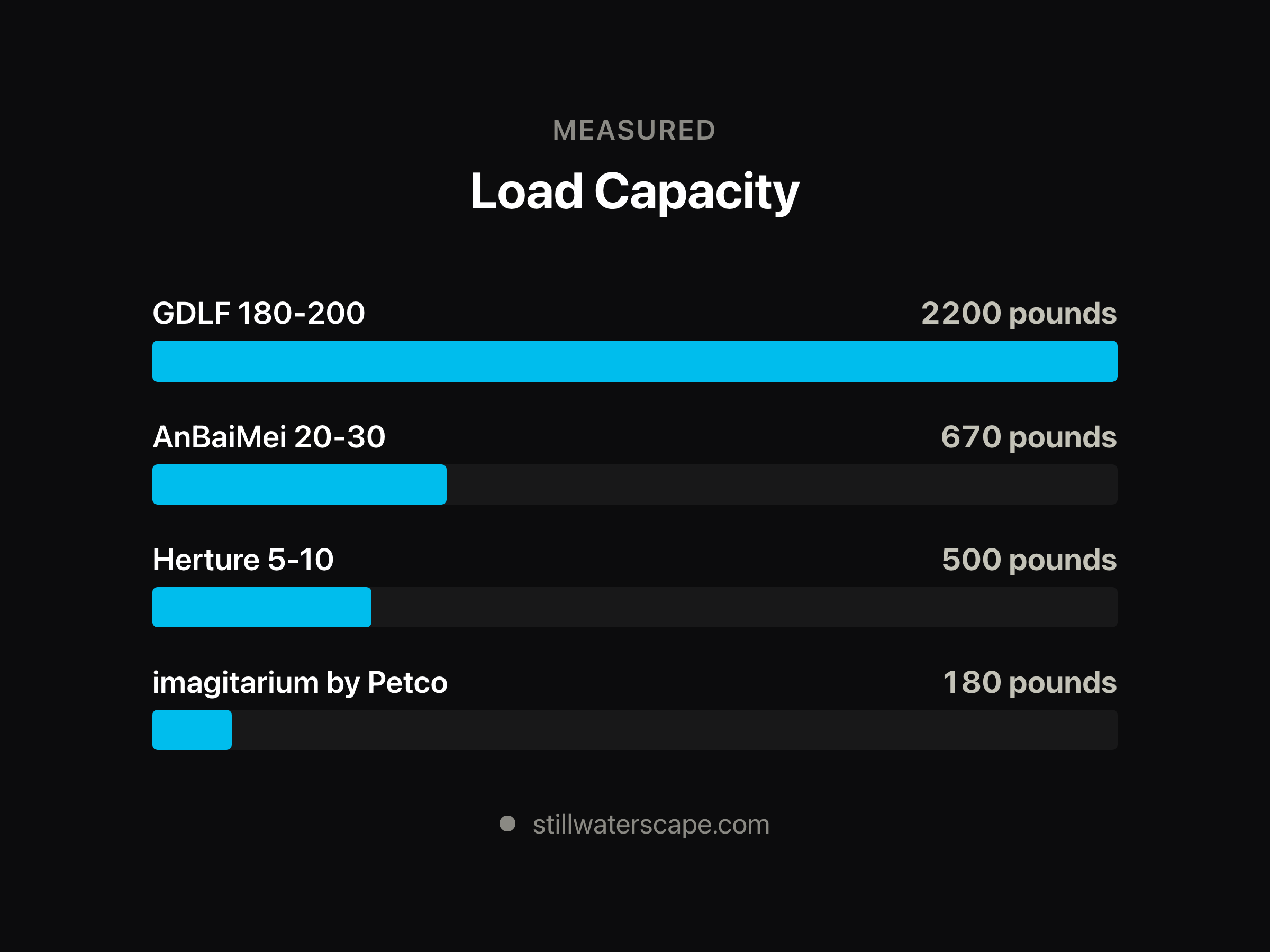
- 72 x 24 in. top rated to 2200 lbs, with a separate 550 lb rating for the bottom deck
- Enclosed cabinet interior sized for a sump system rather than open shelving
- But: Stand weighs 130 lbs on its own, so it is awkward to position or move once built
- But: Single-level top only — no adjustable interior shelf heights
AnBaiMei 20-30 — Best adjustable shelving
- Capacity published per shelf — 320 lbs top, 200 lbs middle, 150 lbs bottom, 670 lbs total
- Middle shelf takes a second 5-20 gallon tank and offers 4 height positions
- But: Top shelf 320 lb limit is the number that matters, and a filled 30 gallon with substrate approaches it
- But: 12 in usable board depth is narrower than the 13 in stated size suggests
Herture 5-10 — Best double tank
- Powder-coated thick steel with MDF panels; enclosed middle cabinet hides food, nets and gravel cleaners
- Lower shelf is rated to hold a second tank, not just decor
- But: Listing gives conflicting numbers — 500 lb top and 300 lb bottom in the description against 330 lb and 110 lb in the spec table — so plan to the lower pair
- But: Product size in the specs (30.7 in wide) does not match the 20.5 in tabletop in the title, so measure before committing
Snughome 10 — Best small space
- Narrow 20.47 x 11.42 in. footprint at 30.91 in. tall
- 220 lb top rating covers a filled 10 gallon with margin, plus 66 lbs on the bottom tier for a 5 gallon
- But: Caps out at 10 gallons — no path to a larger tank later
- But: Engineered wood is vulnerable if water sits on a seam
imagitarium by Petco Newport — Best furniture look
- Wooden cabinet styling at 24.75 x 12.75 x 30.25 in. for a 20 gallon tank
- Adjustable nylon leveling feet protect flooring
- But: 180 lb load capacity — a filled 20 gallon plus substrate leaves little headroom
- But: Unfinished surface needs sealing to survive splashes and drips
Which of these five suits which tank
None of these five have been measured here. Every figure below comes from the manufacturer's listing, and the derates come from named third parties.
The Imagitarium Newport is the clearest case of the headroom trap. The listed dimensions are 24.75 x 12.75 x 30.25 in. with a 180 lb rating. A filled 20-gallon with substrate sits between 225 and 250 lbs depending on which convention you use, so the stated rating is already short of the load. Tropical Aquariums SA reports it wobbles, wants wall anchoring, and works best under 15 gallons — roughly a quarter below the printed number, and calls its reliability questionable for tanks approaching its stated capacity.
TankZen's own guidance is that a stand's rating applies to the tank on top, not to its interior shelves, and no source states whether a rating covers water alone or water plus substrate, rock and equipment.
For the small end, TankZen advises aiming for 200+ lb capacity on 10–29 gallon tanks, at $40–$100, and notes metal stands for standard footprints run $40–$150 and support 200–800 lbs depending on model.
For the top of the range, TankZen recommends a metal stand rated 500+ lbs for tanks over 75 gallons, and for 75–200 gallon tanks advises steel frame stands rated 600+ lbs with welded cross-bracing on the legs, at $80–$300.
Back to the 25-pound gap. No source resolves which loaded-weight figure a buyer should size against, and none quantifies how far below a printed rating to derate.
Which one, then?
GDLF 180-200, best for for a 180-200 gallon build where the filled tank plus rock and substrate runs well past a ton and a sump has to live underneath.
If your case is different:
- For for a 20-30 gallon tank where the middle shelf has to carry a second tank and the shelf height must be tuned to it: AnBaiMei 20-30.
- For for running two small tanks in one footprint while keeping food, nets and gravel cleaners behind a cabinet door: Herture 5-10.
- For for a 5 or 10 gallon tank squeezed into a narrow gap where a wood-look piece has to double as shelving: Snughome 10.
The GDLF 180-200’s weak spot: stand weighs 130 lbs on its own, so it is awkward to position or move once built
Questions
How much weight can a fish tank stand hold?
It depends on the model, and the printed number is a starting point only. TankZen suggests 200+ lbs capacity for 10–29 gallon tanks, 500+ lbs for tanks over 75 gallons, and 600+ lbs steel frames with welded cross-bracing for 75–200 gallons. Metal stands range roughly 200–800 lbs.
How much does a 55 gallon tank weigh fully loaded with gravel and rock?
Published figures disagree. TankZen's loaded-weight table puts a filled 55-gallon at about 600 lbs; AQQA, working from a 48 x 13 x 20 in. tank, says about 625 lbs. TankZen also notes gravel, rocks, decor and hardware can push a 55-gallon past 600 lbs on their own.
Why do aquarium weight calculators give different answers?
Mostly the water constant. TankZen calculates at about 8.3 lbs per gallon, while Framing Technology builds its figures on 10 lbs per gallon. At 100 gallons those two conventions differ by 170 lbs. No source reconciles them, so treat the published figure as a floor rather than the answer.
Does a sump add to the stand's weight capacity?
A sump and its water sit on the bottom deck, not the rated top. TankZen notes a stand's stated rating applies to the tank on top, not to its interior shelves. No source publishes a shelf rating or a sump weight, so the sump load is unaccounted for by the headline number.
How do I know the capacity of a used or unbranded aquarium stand?
No published method assigns a rating. Tropical Aquariums SA says there is no certain way to know, and suggests sitting on the stand and listening for squeaks if your weight approaches the tank's. Then fill in 25% increments, checking after each, somewhere you can mop. Old TV stands don't qualify.
Can you go over the weight capacity of a fish tank stand?
No source gives failure rates, collapse modes, or the safety factor inside a published rating, so there is no margin you can rely on. Non-weight conditions matter as much: full-perimeter contact with no front-to-back overhang, and a flat top — even 1/8" of tilt cracks glass or stresses silicone seams.
How much weight can a floor hold under an aquarium?
No source in this evidence gives a pounds-per-square-foot threshold. Framing Tech states the floor must itself carry the total setup weight, and AQQA advises having floor capacity checked by someone qualified for massive tanks, especially upstairs or in older buildings. On carpet, use 3/4" plywood to spread the load.
Sources
- RSS Feed - Best Aquarium Stands For Your Tank Setup! | Tropical Aquariums SA accessed 2026-08-03
- The BEST Budget Aquarium Stand and It Will Hold up to 1400lbs! - YouTube accessed 2026-08-03
- 5 Key Factors When choosing a Fish Tank Stand - AQQA-Your Aquarium's Best Friend accessed 2026-08-03
- Guidelines for Choosing an Aquarium Stand | Framing Tech accessed 2026-08-03
- Fish Tank Stand Guide: Metal vs Wood, Weight Limits & Setup… | TankZen accessed 2026-08-03