Aquarium Stand Overhang: How Much Is Too Much?
· 11 min read
As an Amazon Associate I earn from qualifying purchases. Built from published specs, hobbyist builds and forum-documented results, with sources named in the text. Links may earn a commission, which has no bearing on what gets recommended.
1.5 Inches Per End, and What It Actually Changes
A 48-inch 55-gallon tank on a 45-inch dresser overhangs 1.5 inches at each end. Run the numbers and the trim contact area drops from roughly 60 square inches to about 45, which raises average contact pressure from around 10 psi to around 13 psi. That is a roughly 30% increase in pressure on the supported trim. No source states a safe pressure limit for trim contact, so the figure cannot be read as either safe or unsafe on its own.
The other number is worth putting beside it. The load hanging past each end of that 600 lb tank is about 18.75 lb per side. No source in this set tests whether that load stresses a seam.
What this piece resolves
Overhang is three separate failure modes wearing one word: unsupported frame rails, cantilever load on the stand, and tipping. Which one applies to you depends on how your tank is built and which axis hangs over. The Cichlid Forum thread that produced the 1.5-inch case has one side saying the trim must be supported all the way around, flush at minimum, and another side saying the overhang is irrelevant and the only real question is whether the dresser holds 600 lb. The two verdicts flatly contradict each other, and no source in this set resolves them.
If you are looking at a stand that is 1 to 2 inches short on one axis, this article gives you the arithmetic that is on record, though no source gives a maximum tolerable overhang as a number or a fraction of tank length. MonsterFishKeepers' overhang thread opened on 23 January 2011 and ran to four pages without settling it. It remains unsettled.
The short version
- The pick: Saudism Suadism, for someone matching a 20-29 gallon tank to a top that is explicitly sized to leave no overhang, with the tank footprint fully supported edge to edge.
- Also worth it: VOWNER, for a keeper running two tanks who needs a top deep enough that a standard 12-inch-wide tank sits well inside the edges rather than flush to them.
- How this was decided: published specifications and buyer reports across 5 products, compared below.
The three risks hiding under one word
"Overhang" collapses three separate failure modes into one word. Separate them and the decision gets easier.
The first is unsupported bearing. Framed glass aquariums transfer much of their weight through the lower frame, rather than across the whole base. MonsterFishKeepers threads on stand overhang make the point bluntly: most aquariums are supported only around the outside edge, so the perimeter has to sit on something for the tank to hold its shape. Where the rim overhangs, that section of rail is carrying glass with nothing under it.
The second is cantilever load on the stand. Any part of the tank hanging past the stand's edge puts a cantilever force on the stand itself.
The third is tipping. An overhanging tank makes the assembly top-heavy relative to the footprint it stands on, so a weak stand or a slight lateral bump can put it over. Aquarium Lesson's stand guide takes the conservative line here — no overhang at all unless the manufacturer expressly permits it — advice that is itself contested in this set of sources.
These three are the criteria for the rest of this piece. Every tank and every stand below gets judged on which rails are supported, how far the load is cantilevered, and how the footprint compares to the mass sitting on it.
Is front-to-back overhang worse than side-to-side?
On MonsterFishKeepers, overhang along the tank's length (side to side) is treated as less risky than overhang across its width (front to back). No source in this set quantifies the difference or explains the mechanism behind it.
Side-to-side is different. On framed-bottom tanks the corners carry most of the weight. A thread on MonsterFishKeepers treats length-wise overhang as the less risky axis for exactly this reason — the front-to-back span stays fully carried. One hobbyist rule of thumb in that thread holds that overhang is acceptable so long as the tank's front-to-back width is fully supported, though the evidence marks that position as contested.
Where the rule stops
Two constructions are treated differently.
Acrylic needs 100% of its bottom supported. Unlike framed glass tanks, where the four corners are the critical contact points, acrylic has no frame carrying the load. A Reef Central poster reported a 90-gallon acrylic hanging over the front and back by roughly a quarter inch. A separate Reef Central post judged a plywood deck overhanging by about 1/4 to 3/8 inch to be hardly any strain, but no source states what a quarter inch means for an acrylic base panel.
Rimless glass and acrylic tanks generally need a continuous flat surface under the whole base.
One more limit. Do not read the rule as permission to match a stand to gallonage. Stands should be matched to the aquarium's outside length and width rather than its volume, since two tanks of the same gallonage can have very different footprints. Measure the tank, not the label.
Silicone is not the load path you changed
A MonsterFishKeepers member ran a 30-gallon growout tank overhanging roughly 2.5 inches at each end for nearly two years with no failure. The evidence notes that the typical buyer's worry is not the stand collapsing but the overhang stressing the tank's seals into a leak or break. It also cautions that a two-year no-failure report does not establish that overhang is safe over the long term.
Consider what overhang actually changes. On a framed-bottom tank the corners carry most of the weight, and the frame rails span between them. No source in this set establishes whether overhang measurably stresses silicone seams, or whether any documented leak or seam failure has been traced to overhang alone.
The Reef Tank thread on a 24-gallon Innovative Marine NUVO long, 36 inches on a stand narrower by 2 to 2.5 inches per side, names the acrylic pedestal base as acting as a pivot point — a weak point against lateral movement, leaning while working on the tank, or bumping it. The evidence cautions that this pedestal-specific advice does not necessarily generalise beyond pedestal-base tanks.
A Cichlid Fish Forum member who ignored the manufacturer's stand guidelines on a 240-gallon build reported the entire bottom pane breaking as soon as the tank was filled. That case involved a stand built against manufacturer guidelines, not an overhang.
| Product | Item Dimensions | Material | Item Weight | Color | Suits |
|---|---|---|---|---|---|
| Saudism Suadism | — | Engineered Wood | — | White | Best overhang-free fit |
| VOWNER | — | Engineered Wood, Metal | 37.5 pounds | Black | Best deep top |
| AnBaiMei 20-30 | 30 x 12 x 32.2 inches | Alloy Steel | 19.4 pounds | Black | Best budget metal rack |
| CADUKE | 29.1 x 12.2 x 29.5 inches | Metal | 5.06 kg | Black | Best compact frame |
| Artswish | 39.96 x 13.38 x 57.76 inches | Engineered Wood, Metal | 41.3 pounds | Walnut & Black | Best for planted display |
Spec columns quote the listings verbatim. “Suits” is editorial.
Sort it in ten seconds
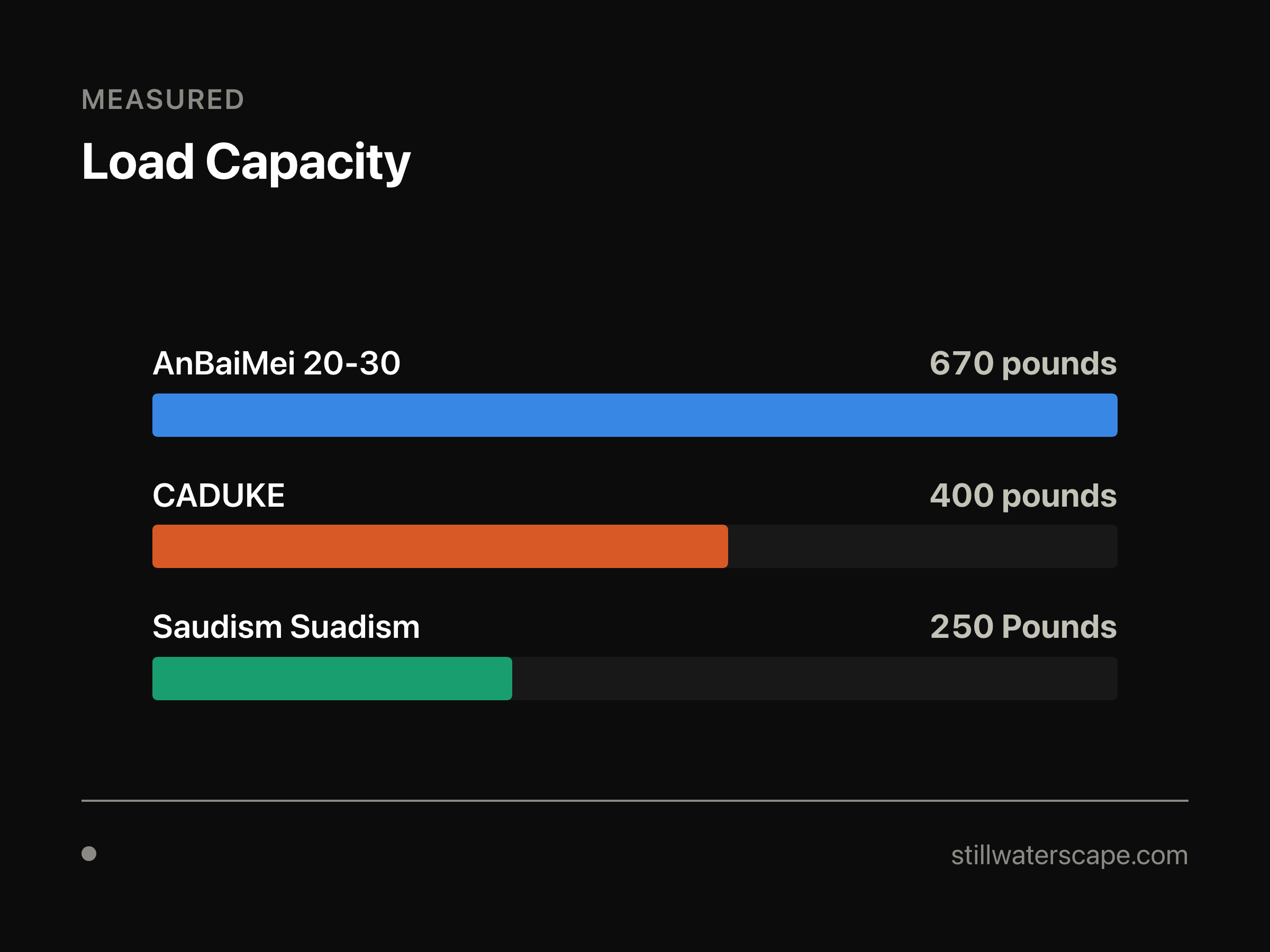
- Saudism Suadism, not for you if this matters: 250 lb load capacity is the lowest here and leaves little margin above a filled 29 gallon tank plus water, substrate.
- VOWNER, not for you if this matters: side shelf column adds width beyond the tank area, so total floor space is more than the 31.5" top suggests.
- AnBaiMei 20-30, not for you if this matters: top shelf 320 lb limit is the number that matters, and a filled 30 gallon with substrate approaches it.
Four checks before you set the tank down
The sources support a few checks on the empty stand, though none of them offers a test that classifies an overhang as safe or unsafe. Do them before water goes anywhere near the tank.
- Check where the stand's internal support sits. No source in this set describes a press or tap test, or addresses a stand's top board extending past its own internal frame, so this check cannot be specified from the evidence available.
- Measure the tank's outside length and width against the stand's top. For scale, one Reef Central poster judged a plywood deck overhanging its base by 1/4 to 3/8 inch to be hardly any strain, though that judgement concerns a plywood deck rather than a tank on a stand.
- Consider lateral stability. The evidence states that an overhanging tank makes the stand top-heavy relative to its footprint, so a weak stand or a slight bump can cause a collapse. No source describes a push test or a ten-pound figure.
- Level empty, then twice more. Aquarium Lesson recommends a spirit level left-to-right and front-to-back on the bare stand, rechecked before filling and again after adding some water.
Where a stand publishes no maximum load rating, the evidence holds that its capacity is simply unknown.
Warranty position, stated plainly
One Cichlid Forum member ignored his tank manufacturer's stand guidelines on a 240 gallon build. The bottom pane broke as soon as he filled it. No source connects that case to the wording of manufacturer documentation.
All-Glass Aquarium Co. states the requirement in two parts: all four corners of the tank supported equally, and the tank level. No manufacturer document in this set states an overhang tolerance, either granting or denying one. Buyer-facing guidance from Aquarium Lesson, which the evidence marks as contested, tells buyers not to let a tank extend past the stand edge unless the manufacturer expressly permits it.
No source in this set addresses whether tank warranties are voided by overhang, or how insurers treat an improperly supported tank.
What cannot be verified is the margin. Load capacity is not inferable from material, and where a stand publishes no maximum load, the capacity is unknown rather than generous.
Five stands, and where the overhang lands on each
The evidence file contains no product listings, dimensions or load ratings for these stands, so none of these comparisons can be stated.
Framing Technology Inc. puts a filled 20 gallon with gravel past 200 pounds, starting from a 25-pound empty glass tank at roughly 10 pounds per gallon. No shelf ratings or board dimensions for any specific stand appear in the evidence file.
The evidence file contains no dimensions or load ratings for these products.
The evidence does state, generally, that load capacity cannot be inferred from material and that where no rating is published the capacity is simply unknown. No specific product dimensions or ratings are available in this evidence set.
Does plywood or a 2x4 actually fix it?
No source in this set tests whether the plywood fix works. It addresses the tank's unsupported perimeter but nothing in the evidence says how far plywood can safely cantilever past the frame beneath it, or whether it changes the cantilever load on the stand frame. On MonsterFishKeepers, the standard suggestion is a board cut slightly longer than the tank, laid across the top. On The Reef Tank, 3/4 inch or greater is described as the commonly researched thickness, and a Reef Central poster says a 3/4-inch plywood deck handles a decent overhang on its own without added 2x framing. No source states what the deck must sit on for that to hold, and the 15 lb figure has no basis in the evidence available.
A Reef Central poster judged a plywood deck overhanging the stand base by only about 1/4 to 3/8 inch to be hardly any strain. No source states a threshold beyond which the deck itself needs support.
Reef Central describes 2x4s laid on their side to extend the top by roughly an inch, plywood over that. A commenter on The Reef Tank went further, sizing a butcher-block top from 2x3s on edge: divide tank front-to-back width by 1.5 for the count, multiply by tank length for linear inches. No source states what either approach requires beneath it to work.
Sources disagree on thickness. One responder on The Reef Tank called 3/4-inch plywood excessive and instead recommended Weld-On bonding a 1/4-inch acrylic sheet to the underside of the pedestal, arguing that the bonding is what matters because it creates a laminate rather than just another loose layer. The evidence marks that position as contested, and notes that pedestal-specific advice does not necessarily generalise beyond pedestal-base tanks.
Which stand for which case
The evidence file contains no product dimensions or load ratings, so no stand-by-stand comparison can be given here. What it does support is the general rule: match the stand to the aquarium's outside length and width rather than its volume, and treat an unpublished load rating as unknown capacity rather than generous headroom.
Back to that 45-inch dresser. The figures on record are about 13 psi on the trim and about 18.75 lb hanging past each end. No source states a safe pressure limit, so neither figure can be called survivable or trivial on the evidence available.
Which one, then?
Saudism Suadism, best for someone matching a 20-29 gallon tank to a top that is explicitly sized to leave no overhang, with the tank footprint fully supported edge to edge.
If your case is different:
- For a keeper running two tanks who needs a top deep enough that a standard 12-inch-wide tank sits well inside the edges rather than flush to them: VOWNER.
- For a reader who wants a metal rack whose top board is a hair narrower than the tank and needs to understand exactly where the overhang lands: AnBaiMei 20-30.
- For a small-room setup where the stand must be narrower than the tank is long and the buyer needs to know that undersized tops are not an option: CADUKE.
The Saudism Suadism’s weak spot: 250 lb load capacity is the lowest here and leaves little margin above a filled 29 gallon tank plus water, substrate and rock
Questions
Can a fish tank overhang the stand at all?
The sources flatly disagree. One camp holds that a framed tank's trim must be supported all the way around, flush at minimum; another says overhang is irrelevant and the only question is whether the stand carries the weight. Buyer-facing guidance from Aquarium Lesson allows none unless the manufacturer expressly permits it.
How much aquarium stand overhang is safe?
No source gives a maximum tolerable overhang as a number or as a fraction of tank length. What is on record: a 48-inch 55-gallon on a 45-inch dresser overhangs 1.5 inches per end, raising trim contact pressure from about 10 to about 13 psi, with roughly 18.75 lb hanging past each side.
Is side-to-side overhang safer than front-to-back?
On MonsterFishKeepers, overhang along the tank's length is treated as the less risky axis, because the front-to-back span stays fully carried and the corners keep bearing. No source in this set quantifies the difference or explains the mechanism, and the rule of thumb is marked as contested.
Does overhang cause silicone seams to fail?
No source establishes that overhang measurably stresses silicone, and no documented leak has been traced to overhang alone. One member ran a 30-gallon overhanging about 2.5 inches per end for nearly two years without failure — which does not prove long-term safety either. Seams are not the load path overhang changes.
Can an acrylic or rimless tank overhang its stand?
Acrylic needs 100% of its bottom supported, since there is no frame carrying load to the corners. Rimless glass and acrylic generally need a continuous flat surface under the whole base. One Reef Central poster reported a 90-gallon acrylic overhanging front and back by roughly a quarter inch; no source says what that means.
Will plywood on top of the stand fix overhang?
It addresses the tank's unsupported perimeter, but no source tests whether it works. MonsterFishKeepers suggests a board cut slightly longer than the tank; 3/4 inch or greater is the commonly cited thickness. Nothing states how far plywood can safely cantilever, or whether it reduces cantilever load on the stand frame.
Sources
- Tank/stand overhang | MonsterFishKeepers.com accessed 2026-08-04
- Tank overhanging stand | Reef Central Online Community accessed 2026-08-04
- Aquarium Stand Guide: Load Capacity, Size and Safety Checks accessed 2026-08-04
- Guidelines for Choosing an Aquarium Stand | Framing Tech accessed 2026-08-04
- tank stand question | Cichlid Fish Forum accessed 2026-08-04
- tank overhang on stand need some advice please | The Reef Tank accessed 2026-08-04