Aquarium Heater Wattage: How Many Watts Do You Need?
· 12 min read
As an Amazon Associate I earn from qualifying purchases. Built from published specs, hobbyist builds and forum-documented results, with sources named in the text. Links may earn a commission, which has no bearing on what gets recommended.
The 30-gallon tank that three sources size at 75W, 100W and 150W
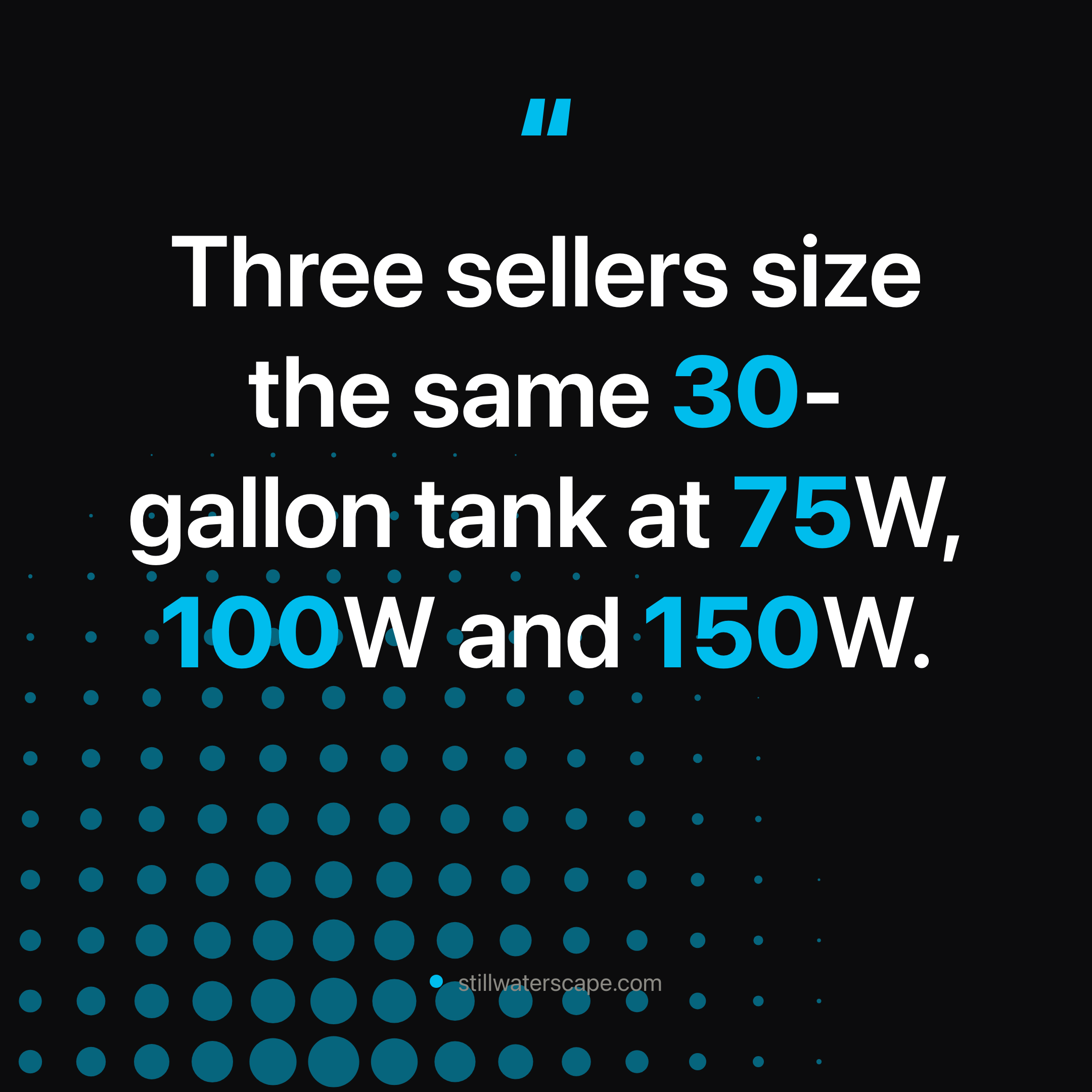
A 30-gallon tank sits in an unheated spare room. Three sizing pages, all from people who sell fish equipment, put the aquarium heater wattage at 75W, 100W and 150W. They disagree, and none of the pages acknowledges that the others exist or explains why the number differs.
Aquarium Co-Op applies a flat 5 watts per gallon at every tank size, and works its rule through to a 100-watt heater for a 29-gallon tank. Aqueon tiers the same rule: 5 watts per gallon at 55 gallons and under, dropping to 3 watts per gallon above 60 gallons. The Pleco Feeder gives a band of 2.5 to 5 watts per gallon, which lands a 30-gallon tank anywhere between 75W and 150W and a 10-gallon tank between 25W and 50W.
So the buyer's result depends on which page they landed on. Same tank, same fish, double the wattage.
Here is what the three rules produce for a 30-gallon tank:
- Aquarium Co-Op, flat 5 W/gal: 150W by arithmetic, though its own worked example puts a 29-gallon tank at 100W
- Aqueon, 5 W/gal under 55 gallons: 150W
- The Pleco Feeder, 2.5–5 W/gal: 75W to 150W
The Pleco Feeder is the only one of the three carrying a climate correction, at another 2.5 to 5 watts per gallon for every 9°F of additional temperature difference the heater must cover. Aquarium Co-Op's flat 5 W/gal is not a general rule either — it holds only where the water needs no more than a 10-degree rise above room temperature and the tank has a lid.
This piece rebuilds the sizing decision around that gap rather than gallons. If you know your coldest room temperature and your target, you will finish able to pick a wattage and say why the number is what it is.
The short version
- The pick: Aqueon, for budget 100W submersible for tanks up to 40 gallons.
- Also worth it: DaToo 10, for 10W for 1–1.5 gallon betta bowls, the smallest wattage step.
- How this was decided: published specifications and buyer reports across 12 products, compared below.
Sizing by required temperature rise
Start with two numbers: the coldest your room gets in February, and the temperature your fish actually want. Subtract. That gap is what sets wattage, and it is the only input most charts leave out.
The target end varies by source. The Pleco Feeder places most tropical fish at 75-80°F; Aquarium Co-Op puts the same broad group slightly warmer, at 78-80°F. Aqueon splits it further — 76-85°F for bettas and discus, 75-80°F for other tropicals, 68-74°F for goldfish. Aquarium Co-Op puts discus, ram cichlids and some Apistogramma at around 85°F, and says goldfish, Japanese ricefish and white cloud mountain minnows prefer cooler water and would be fine with no heater at all.
Take the warmest number in your species' range if you keep discus. Take the middle for a community tank. Then measure the room, not the hallway.
The gap, not the gallons
The Pleco Feeder's chart is indexed on required rise, in three tiers: 9°F, 18°F and 27°F. A 5-gallon tank sits at 25, 50 and 75 watts across those tiers. A 50-gallon tank runs 150 watts at a 9°F rise, 200 at 18°F, and 300-400 at 27°F. At 100 gallons it is 250-300 watts for the smallest gap and 500-600 for the largest — double the wattage for identical volume.
The finest-grained figure in that chart is the 10-gallon: about 50 watts for an 8-10°F rise, 75 watts for 16-18°F. Same tank. Same fish. A 50% difference in heater, decided entirely by where the tank lives. The Pleco Feeder's correction factor is 2.5 to 5 additional watts per gallon for every 9°F of extra difference the heater must close, which is worth applying directly if your gap falls between the tiers.
One correction before you read the table. Size to water volume, not the tank's nominal rating — a heavily decorated 10-gallon aquarium may hold only 5 or 6 gallons once substrate, rock and wood displace the rest. The Pleco Feeder makes this point explicitly. No page gives a method for estimating how much substrate, rock and decor actually displace, so the correction is left to the reader. Check your actual fill before anything else.
Aqueon does note that a tank in an especially cold room, against an exterior wall, or near an outside door calls for more wattage or a second heater.
Where the per-gallon rule stops working
The 5 watts per gallon rule carries two conditions. Aquarium Co-Op states them plainly: the water must need no more than a 10-degree rise above room temperature, and the tank must have a lid. Drop either one and the arithmetic stops holding. Aquarium Co-Op names evaporative cooling as the reason the lid matters, but no page quantifies how much extra wattage an open-top tank needs.
The breakdown point is specific enough to test your own setup against. Take a 65°F house and a 80°F target — a 15-degree rise. At that gap Aquarium Co-Op abandons single-heater scaling entirely and tells you to run a second heater instead of buying a bigger one. Aquarium Co-Op's stated precondition is a rise of no more than 10 degrees, and at a 15-degree rise it advises a second heater; the range in between is not addressed by any source.
Three things shift the gap without changing the tank:
- Where the tank sits in the room. Aqueon says to upsize the wattage or add a second heater when the tank sits in an especially cold room, against an exterior wall, or near an outside door.
- Where it sits on the rack. Aquarium Co-Op notes that because heat rises, tanks on the bottom shelf of a rack run cooler than those on top.
- What else is plugged in. Aquarium Co-Op points out that a Fluval FX4 canister draws 30 watts and warms the water passing through it. No page says whether to subtract equipment wattage from the sizing calculation or treat it as margin.
Measure the delta at the tank rather than at a thermostat elsewhere in the house.
| Product | Item Dimensions LxWxH | Item Weight | Color | Included Components | Suits |
|---|---|---|---|---|---|
| DaToo 10 | 1.9 x 0.24 x 3.9 inches | 7 ounces | — | — | Best for tiny tanks |
| VCRAZE 25W Compact | 0.9 x 0.9 x 4 inches | 5.28 ounces | Black | Aquarium heater, Suction cup | Best space-saving |
| Penn-Plax Cascade | 1.1"W x 7.5"H | — | Multicolor | — | Best knob control |
| hygger Small | — | 0.27 kg | Black | — | Best wattage range |
| Tetra HT | — | 7.84 ounces | Black | Aquaria 75026447: Tetra Submersible Aquarium Heater 50Wt | Best no-settings heater |
| Fluval M 50-Watt | — | 9.92 ounces | Silver | Fluval M50 Submersible Glass Aquarium Heater (50 watts) | Best hidden design |
| AquaMiracle | 0.9 x 0.9 x 5 inches | 0.25 kg | Black | Aquarium heater | Best compact/small tank |
| EHEIM Jager | 0.00 x 1.42 x 12.56 inches | 10.24 ounces | RED | All | Best mid-size tank |
| Aqueon | — | 8.8 ounces | Multicolored | Aqueon Submersible Aquarium Heater, 100 Watts, Up to 40 Gallons | Best fine adjustment |
| hygger Pinpoint | 1.3 x 10.7 x 1.3 inches | 1.98 pounds | Silver | thermostat | Best saltwater/reef |
| AQQA | 200W for 45-80 Gallon | 1.98 pounds | — | — | Best after power cuts |
| FREESEA 300 | — | — | Black | Diving Thermometer | Best for cold rooms |
Spec columns quote the listings verbatim. “Suits” is editorial.
Sort it in ten seconds
- DaToo 10, not for you if this matters: freshwater only, not usable in marine tanks.
- VCRAZE 25W Compact, not for you if this matters: 25W caps it at about 5 gallons.
- Penn-Plax Cascade, not for you if this matters: 25W suits only tanks up to about 5 gallons.
Four checks on the heater you already own
Before replacing a heater, measure what it is actually doing. No source in this set gives a diagnostic procedure for judging an installed heater, so what follows is reasoning from the sizing advice rather than tested guidance.
- Watch the heater's cycling behaviour. No source in this set documents indicator-light colour conventions or a threshold for reading them, so treat this as inference rather than a specification.
- Log the overnight drop. Read the water at bedtime and again before the heating comes on. No source gives a threshold fall that distinguishes insufficient wattage from a thermostat fault.
- Check where the heater sits relative to flow. Aquarium Co-Op puts the heater next to the filter output or pump and the thermometer in the opposite corner. The stated reason is flow: the heater should sit where water moves past it.
- Compare set point against delivered temperature. Modest Fish had to set a 200-watt Hygger controller to 77°F to hold 75°F in a 55-gallon tank, while the same unit performed fine in a 40-gallon. No source explains why, or offers a general threshold for the gap between dial and water.
Give each change several hours before you judge it. Aqueon says the same, and adds that dial position may need adjusting for tank location, room temperature and circulation regardless of rating.
Why 'just size up' is bad advice in a 10-gallon tank
"Buy one size up" is advice written for big tanks. No source gives heating rates by volume, but the failure-mode reasoning below is stated directly by two of them.
Aquarium Co-Op puts the ceiling at 25W or less for nano tanks of 6 gallons or under, and lower still depending on room temperature. That is not a heating recommendation. It is a failure-mode recommendation. Aquarium Co-Op's reasoning is that a heater too small to overheat the tank on its own cannot cook it if it sticks on.
Mark Valderrama of AquariumStoreDepot makes the same argument from the other direction: an accuracy rating means nothing if the unit fails in the on position and turns the tank into a hot tub. His reframing is worth keeping. Stability is holding 78°F when something goes wrong at 2am, not hitting 78°F on a calm afternoon.
Overheat cut-offs do not close the gap. Modest Fish notes that one Hygger unit's sensor does not cut power until the water reaches 97°F, by which point, it says, the fish would be long dead. No manufacturer source in this set publishes a cut-off figure or states what a safe threshold would be.
The ceiling carries a trade-off the sources do not quantify: no page says what room temperature a 25W nano heater can still bring to a tropical target. The VCRAZE 25W with its 4-inch body sits at that limit.
Twelve heaters against the temperature-gap criteria
None of these are measured here. Every figure below comes from the manufacturer's listing, read against the rise tiers already set out: 9°F, 18°F, 27°F. The useful question for each is not "how many gallons" but "how many gallons at what gap". Several of the twelve answer that badly, and the listings themselves are where the disagreement shows.
Start at the bottom. DaToo's 10W flat PTC panel is listed at 1.9 x 3.9 inches and about a quarter-inch thick, self-limiting to roughly 75–82°F with no set point at all, according to its listing. How it performs at a given room temperature is not something any source in this set tests. Aquarium Co-Op's ceiling of 25W for anything under 6 gallons puts the VCRAZE 25W and the Penn-Plax Cascade Heat at the top of the nano range, not the middle of it — per their listings.
Where the nameplate and the tank rating fight
Modest Fish found a Hygger unit sold as 200 watts rated by its own maker for 15–30 gallon aquariums, while the 100-watt Fluval E200 is rated by Fluval to 65 gallons — half the wattage for a larger tank. No source gives the test method or assumed conditions behind any manufacturer's 'up to X gallons' rating, which is why such figures cannot be compared across brands.
Which heater suits which room
That 30-gallon tank in the unheated spare room, sitting at 62°F and targeting 78°F, needs to close a 16-degree gap. Aquarium Co-Op's rule breaks down in a 65°F house needing a 15-degree rise, at which point it advises adding a second heater rather than scaling the single one; The Pleco Feeder splits the load across two units at 50 gallons and above. Where 200 watts is required, Aquarium Co-Op recommends two 100W heaters rather than a single 200W unit. The Aqueon Submersible Aquarium Heater is available at 100 watts. Note that no source says whether such a pair should run on separate circuits, be set to the same temperature, or how a silent failure of one would be detected.
Warm room, same tank? A single unit falls within the per-gallon rules, though the evidence set contains no tested figures for specific 100W models.
Match the room, not the gallons:
- Nano, 6 gallons or under: Aquarium Co-Op caps this at 25W or weaker, depending on room temperature.
- 3-5 gallons, cabinet or stand: the VCRAZE 25W sits within Aquarium Co-Op's 25W nano ceiling; its listed accuracy and range are not independently verified here.
- Rimless or open-top: no page quantifies how much extra wattage an open-top tank needs, even though evaporative cooling is named as the reason a lid matters. The Fluval M50 carries a 3-year warranty.
- Larger tanks: The Pleco Feeder recommends splitting the load across a pair of heaters at 50 gallons and above; AquariumStoreDepot argues any tank with real money in it needs a titanium element or PTC unit paired with a redundant controller, a view not corroborated elsewhere in this set.
Before you plug any of them in, let the heater sit in the tank water 20 to 30 minutes. Aqueon says 30 minutes minimum, and 30 minutes cooling before you lift it out.
Warranty length varies widely across the category. AquariumStoreDepot lists the Aqueon Pro Adjustable Heater with a lifetime warranty, the Fluval M50 with 3 years, and the Helio Heater with 5; Aquarium Co-Op's own 100W heater carries 1 year.
Which one, then?
Aqueon, best for budget 100W submersible for tanks up to 40 gallons.
If your case is different:
- For 10W for 1–1.5 gallon betta bowls, the smallest wattage step: DaToo 10.
- For 25W in a very short body for 3–5 gallon nano tanks: VCRAZE 25W Compact.
- For simple 25W non-digital heater for a 5 gallon tank: Penn-Plax Cascade.
The Aqueon’s weak spot: 100W for up to 40 gallons is on the lean side if the room drops far below the target
Questions
How many watts should an aquarium heater be?
Size by the temperature gap the heater must close, not gallons. Published charts index on required rise: a 50-gallon tank needs about 150 watts for a 9°F rise, 200 watts at 18°F, and 300-400 watts at 27°F. Add roughly 2.5 to 5 watts per gallon for every extra 9°F of difference.
Is a 100 watt heater enough for a 30-gallon aquarium?
It depends on the room. Aquarium Co-Op's worked example puts a 29-gallon tank at 100 watts, but that assumes a lid and no more than a 10-degree rise above room temperature. A 30-gallon tank at 62°F targeting 78°F must close 16 degrees, and both Aqueon and Aquarium Co-Op then advise more wattage or a second heater.
Can I use a 100W heater in a 10 gallon tank?
It is more wattage than the sizing charts call for — a 10-gallon tank needs about 50 watts for a 9°F rise and 75 watts for 18°F. Aquarium Co-Op caps nano tanks of 6 gallons or under at 25W precisely so a heater stuck in the on position cannot cook the tank.
Is it better to use two smaller heaters or one big one?
Where 200 watts is required, Aquarium Co-Op recommends two 100W heaters rather than a single 200W unit, and advises a second heater instead of a larger one once the required rise reaches about 15 degrees. The Pleco Feeder splits the load across two units at 50 gallons and above.
Does a lid change what aquarium heater wattage I need?
Yes. The 5 watts per gallon rule assumes the tank has a lid, with evaporative cooling named as the reason it matters. An open-top or rimless tank needs more wattage, though no published source quantifies how much — so treat the per-gallon figure as a floor rather than an answer.
Sources
- The 11 Best Aquarium Heaters Of 2026 [Tested & Reviewed] accessed 2026-08-03
- How to Choose the Right Aquarium Heater | Fish Tank Heaters 101 accessed 2026-08-03
- CHART: Aquarium Heater Wattage Guide accessed 2026-08-03
- Best Aquarium Heater Tested (MOST Safe & Accurate 2024) accessed 2026-08-03
- How to Choose the Right Aquarium Heater | Fish Tank Heaters 101 accessed 2026-08-03
- Fish Tank Heater Tips for Cold Weather accessed 2026-08-03