Aquarium Chiller BTU: Formulas 1,394 BTU/hr Apart
· 13 min read
As an Amazon Associate I earn from qualifying purchases. Built from published specs, hobbyist builds and forum-documented results, with sources named in the text. Links may earn a commission, which has no bearing on what gets recommended.
The 55-Gallon Tank That Three Formulas Cannot Agree On
Size for the load, not the drop. An aquarium chiller BTU figure that matches your tank on paper can still fail in August, because neither published formula states over what period the resulting BTU/hr figure applies, while your tank fights a continuous heat gain from lights, pumps and the room itself.
Take a 55-gallon tank that needs to sit 4°F below where it settles. Three sources give three answers.
The exact form of the standard equation, volume × 8.3 × ΔT, puts it at 1,826 BTU/hr. Bulk Reef Supply, in a guide credited to Robert Farnsworth and last updated 18 May 2026, tells you to round to 10 BTU per gallon per °F instead. That lands at 2,200 BTU/hr, a 374 BTU/hr safety margin bought by rounding alone. Hygger, in an article dated 17 June 2026, starts from 8.34 rather than 8.3, adds estimated equipment heat, then multiplies the total by 1.25.
That third row is where the spread opens. Hygger's 1.25 multiplier applies to the equipment term as well as the water term, so every 100 BTU/hr of pump and lighting heat you enter adds 125 to the requirement. A 55-gallon reef with a return pump, two circulation pumps and an LED fixture pushes the gap between method one and method three past 600 BTU/hr on Hygger's own per-device estimates.
This section is for anyone about to buy on a gallon rating printed on a box. By the end you will know which of the three methods applies to your room, what your own equipment contributes in BTU/hr, and where over-buying costs you in short cycling rather than protecting you. Hygger says the 25% buffer covers hot days, poor ventilation and aging equipment. Two of those three are properties of your room, not your tank.
The short version
- The pick: Aquarium Chiller 15gal, for you need to pull a small reservoir or 10–15 gallon tank well below ambient in a hot room, where headroom matters more than efficiency.
- Also worth it: BAOSHISHAN, for it is the right answer for a 20–30 gallon reef or axolotl tank in a warm room, where a compressor unit sized to a stated 8–10°F pull-down is what the BTU math actually calls for.
- How this was decided: published specifications and buyer reports across 10 products, compared below.
What the 8.3 Formula Actually Models
Volume × 8.3 × ΔT rests on one piece of arithmetic: a gallon of water weighs about 8.3 lb, so roughly 8.3 BTU are needed to drop one gallon by 1°F. Neither source states over what period the resulting figure applies, or whether it represents pull-down or steady-state heat rejection. Bulk Reef Supply publishes it as (tank volume × 8.3) × desired temperature drop = required BTU/hr. Hygger uses 8.34, one gallon's weight in pounds times water's specific heat of 1 BTU per pound per °F. The two multipliers differ by about half a percent. Neither page states what physical situation the resulting figure describes.
The bigger problem is ΔT, because the two most-cited sources define it differently. Bulk Reef Supply takes current water temperature minus target: a tank sitting at 83–84°F aiming for 78°F is a 5–6°F drop. Hygger takes room temperature minus target water temperature, and says to use the hottest ambient the aquarium has ever seen, not the average. Those give different answers on the same tank, and neither page acknowledges the other convention. Hygger also states that the volume used for sizing is tank plus sump.
The number you actually need
No source in this review states a steady-state load formula, or gives a watts-to-BTU/hr conversion for equipment heat beyond Hygger's per-device estimates.
Your choice of glass, mesh or vented lid may matter here, though no source in this review quantifies the effect of surface area, tank geometry or evaporation on heat gain.
Equipment Heat in BTU/hr: The Numbers Nobody Prints
Equipment heat is the term everyone tells you to add and nobody quantifies. Hygger publishes per-device estimates, which are the only figures available here.
- Return pump, 100 W: about 341 BTU/hr. Hygger's estimate.
- Submersible pump, 100 W: about 341 BTU/hr. Hygger's estimate.
- Metal halide, 150 W: about 512 BTU/hr. Hygger's estimate.
- LED, 100 W: 200–280 BTU/hr. Hygger's estimate, lower than its submersible pump figure. Separately, Bulk Reef Supply states most modern tanks on LED lighting and efficient pumps need no chiller at all if the room stays cool and stable.
- Protein skimmer: 100–200 BTU/hr. Hygger's estimate.
Where the three methods diverge
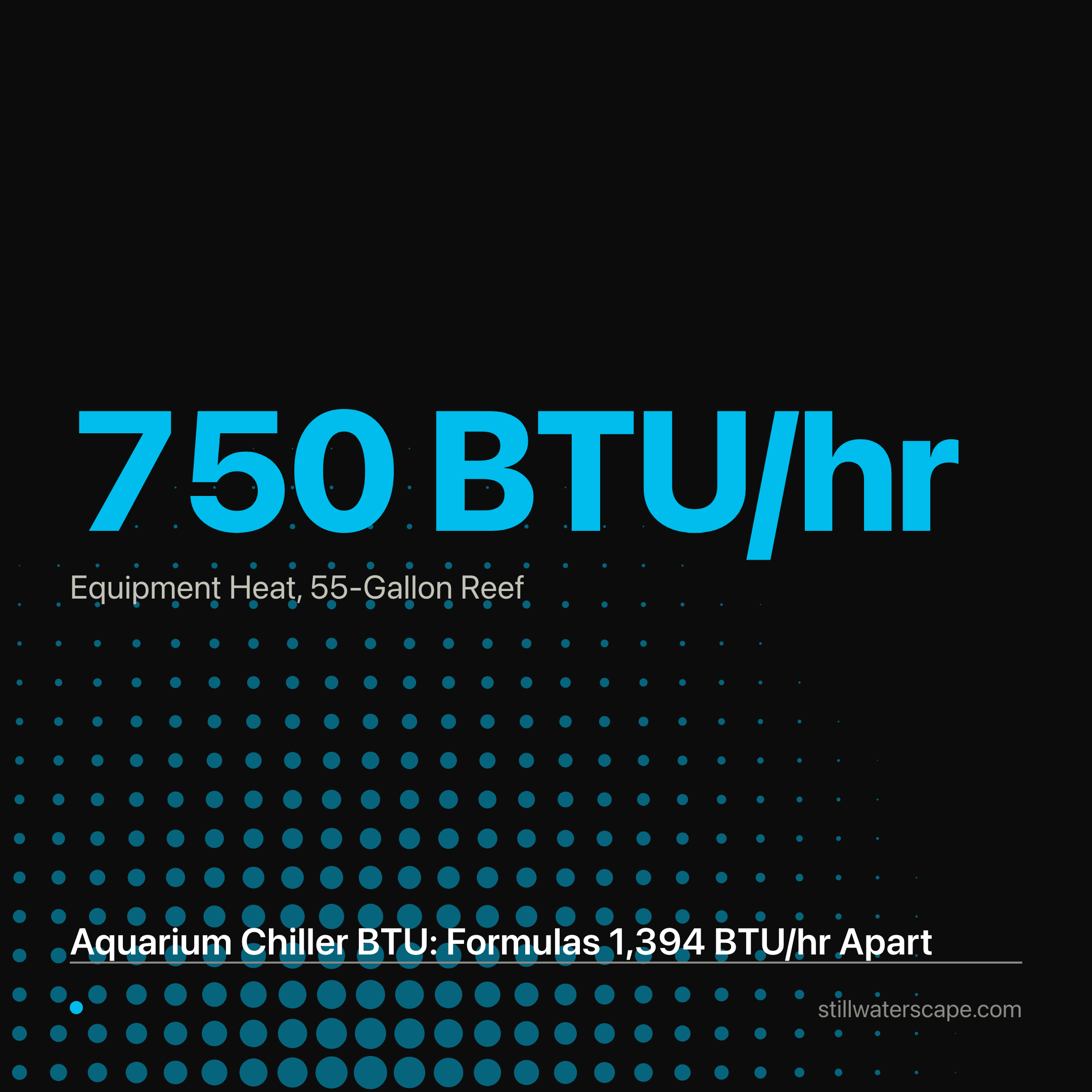
Applying Hygger's per-device estimates to a 55-gallon reef with a 65 W return pump, two 40 W powerheads, 120 W of LED and a skimmer gives roughly 750 BTU/hr of equipment heat.
The 8.3 method ignores it entirely: 1,826 BTU/hr. Bulk Reef Supply's rounded 10 BTU version also ignores it: 2,200. Hygger's (load + equipment) × 1.25 gives (1,826 + 750) × 1.25 = 3,220.
That is a spread of 1,394 BTU/hr on one tank. No source reconciles the methods or says which applies when.
Does room temperature change what size chiller I need?
Yes. Hygger asks you to compute ΔT from room temperature rather than current water temperature, and to use the hottest room temperature the aquarium has ever seen: the peak summer day, not the average.
Bulk Reef Supply puts it directly. In warm or enclosed spaces the condenser cannot shed heat efficiently, so the unit runs longer, cools less, or fails to keep up. Most aquarium chillers use vapor-compression cooling, the same process as a refrigerator or air conditioner.
Then there is the part almost nobody states. The chiller does not remove heat from the room. It moves your tank's heat load into the air beside it, and it adds its own compressor input on top. Penguin Chillers rates its 1 HP unit at 10,000 BTU/hr while drawing 830 W. No source in this review quantifies how much of that draw ends up as heat in the room, or addresses the feedback loop between a chiller's waste heat and the room temperature Hygger's ΔT depends on.
A sensible order of operations:
- Get air moving through the space, or move the tank out of it; Bulk Reef Supply notes placement matters because a chiller moves heat into the air around the unit.
- Keep the fins clean. Dust on the fan and condenser fins blocks airflow, and calcium buildup inside the heat exchanger erodes cooling capacity over time, per Bulk Reef Supply.
- Only then size the compressor.
| Product | Cooling power | Tank capacity | Compressor type | Noise | Suits |
|---|---|---|---|---|---|
| BAOSHISHAN | — | — | — | — | Best for 20–30 gallons |
| Dreamtrue | 1/10 HP | 42 gal | Compressor | Under 45 dB | Best for larger tanks |
| LEYSRIS | 100 W | 7.9 gal | Compressor | Under 40 dB | Best quiet operation |
| HEZHHA | — | — | — | — | Best space-saving |
| FANBINAN | 200 W | 16 gal | Compressor | Under 40 dB | Best nano all-in-one |
| Aquarium Chiller 15gal | 1/10 HP | 15 gal | Compressor | Under 45 dB | Best big-pull small tank |
| 503 - Service Unavailable Error | 72 W | 5.3 gal | Thermoelectric | Under 35 dB | Best near-silent trim |
| 503 - Service Unavailable Error | 1/10 HP | 7.93 gal | Compressor | Under 40 dB | Best for coldwater species |
| 503 - Service Unavailable Error | 180 W | 15.8 gal | — | — | Best fast pull-down |
| 503 - Service Unavailable Error | 100 W | 9.2 gal | Thermoelectric | Under 40 dB | Best heat-and-cool combo |
Spec columns quote the listings verbatim. “Suits” is editorial.
Sort it in ten seconds
- BAOSHISHAN, not for you if this matters: needs 6 inches of clearance on all sides for the heat dissipation fan.
- Dreamtrue, not for you if this matters: pump is sold separately and must meet the stated flow rate.
- LEYSRIS, not for you if this matters: enclosed cabinet placement will choke its exhaust unless vented.
Axolotls and Coldwater: A Different Sizing Regime
Hygger gives a target of 55–68°F for coldwater species, against 76–80°F for freshwater tropical and 75–78°F for reef and saltwater. A coldwater tank in a warm room therefore implies a much larger ΔT than a tropical one. No source in this review states how the BTU figure translates into horsepower, or whether the formula describes a pull-down or a continuous load.
Hygger's own instruction is to size on the hottest room temperature the aquarium has ever seen, which for a coldwater tank means a large ΔT.
The practical consequence
No source in this review quantifies heat gain through tank walls or duty cycle as a function of ΔT. Hygger does say an undersized chiller runs nonstop without reaching set point and will need replacing sooner.
Hygger advises picking the larger unit when the calculated requirement falls between two chiller sizes, and Bulk Reef Supply holds that slightly oversizing is generally better than undersizing. Hygger warns that oversizing brings its own problems. No source in this review gives capacity figures for specific coldwater or nano units.
The Cost of Buying Too Much BTU/hr
Bulk Reef Supply's position is that a correctly sized chiller cycles rather than runs constantly, roughly 15 to 20 minutes per hour, varying with season, room temperature and system load, and that anything longer is worth investigating. Neither source quantifies how little runtime counts as too little.
Hygger warns that an oversized chiller pulls water temperature down fast enough to thermally shock fish, and that its rapid on-off cycling stresses the compressor and shortens its life. Bulk Reef Supply argues the opposite direction, that slightly oversizing beats undersizing, and Hygger itself advises taking the larger unit when your calculation lands between two sizes. The two positions are contested and neither source acknowledges the other, nor does either quantify how much margin is safe. Hygger also says the undersized unit runs nonstop, never reaches set point, and will need replacing sooner.
No source gives a percentage or a BTU-per-gallon figure at which a safety margin becomes a hazard, and none discusses controller deadbands or owner reports of short-cycling.
Each chiller is built for a specific flow rate, and Bulk Reef Supply notes that too much or too little water through it cuts performance, so it advises matching the manufacturer's spec. Flow can be checked with a simple 5-gallon bucket test.
Bulk Reef Supply advises slight oversizing and Hygger advises taking the larger unit between two sizes; neither states a volume threshold or names a figure for "slightly".
Cheaper BTU on the Table Before You Buy Anything
Before you size a compressor, it is worth asking how much heat you can remove another way. No source in this review compares the running cost of a chiller against fans, evaporative cooling or room air conditioning, so the relative economics below are not established.
- Halide to LED, per fixture: Hygger puts a 150W metal halide at about 512 BTU/hr, and 100W of LED at roughly 200–280 BTU/hr. No source gives BTU capacities for nano chillers, so the comparison with a chiller's output cannot be made here.
- Surface fan across an open water surface: no source in this review quantifies the cooling from evaporative fans or its effect on top-off and salinity.
- Removing or venting the lid: no source in this review addresses lids or their effect on heat and evaporation; see glass, mesh and vented lid tradeoffs.
- Placement: Bulk Reef Supply notes a chiller does not eliminate heat but moves it into the air around the unit, which is why placement matters, and that in warm or enclosed spaces the condenser cannot shed heat efficiently.
- A cool, stable room: Bulk Reef Supply states that most modern tanks on LED lighting and efficient pumps need no chiller at all if the room stays cool and stable.
Which Unit Fits Which Room
Bulk Reef Supply's chart puts 40–80 gallon tanks at a 3–5°F drop on 1/10 HP units such as the TECO TK500 or JBJ Arctica 1/10 HP, and it calls that chart a general guideline only, with actual sizing depending on temperature drop, ambient conditions and equipment heat load. Because the chart names models by horsepower only, a reader cannot cross-check it against the BTU math.
The rest of that chart runs as follows:
- Up to 40 gallons, 2–4°F drop: 1/15–1/10 HP (TECO TK150, JBJ Nano Arctica).
- 80–125 gallons, 3–6°F drop: 1/5 HP (TECO TK1000, JBJ Arctica 1/5 HP).
- 125–180 gallons, 4–6°F drop: 1/4 HP (TECO TK2000, JBJ Arctica 1/4 HP).
- 180–300 gallons, 4–7°F drop: 1/3 HP (TECO TK3000, JBJ Arctica 1/3 HP).
- Over 300 gallons, 5–8°F drop: 1/2 HP or larger (TECO TK5000+, JBJ Commercial).
Read the BTU line, not the HP
Where BTU figures are published, they are worth reading closely. Penguin Chillers rates its 1 HP water chiller at 10,000 BTU/hr, listed at $1,899.99. The listing gives it as 110–120V single phase drawing 7.2A and 830W. It works from 37°F to 100°F with water, uses R-32 refrigerant, is rated 59 dBA with 1" female NPT inlet and outlet, measures 19.25" × 19.75" × 14.25", weighs 58–64 lbs and is not outdoor rated.
Same HP, different output
Horsepower alone does not fix output. Penguin's own range makes that plain:
- 1/2 HP standard: 5,000 BTU/hr, 450W, 3.9A at 110–120V, 39 lbs.
- 1/2 HP high-efficiency: 5,750 BTU/hr on that same 450W draw.
- 1 HP high-efficiency: 11,500 BTU/hr on the same 830W as the standard 1 HP.
- 1.5 HP: 15,000 BTU/hr at 11A and 1,270W, 96 lbs.
- 2.5 HP: 25,000 BTU/hr, but on 208–240V at 14.7A and 3,200W.
No source explains what varies between the standard and high-efficiency designs, or gives the ambient, inlet-temperature and flow conditions behind any of these ratings.
Pump and plumbing. Pumps feeding the 1 HP Penguin chiller must be rated under 10 PSI / 23 ft maximum head, and Penguin recommends a Danner Mag Drive 5.0 to 18 pump, with exact sizing depending on the rest of the system.
Thermoelectric. The JBJ Nano Arctica E-Chiller cools thermoelectrically rather than with a compressor, suiting small tanks needing only a few degrees of reduction, and the Nova Tec IceProbe mounts through the tank or reservoir wall and requires drilling. No source gives BTU/hr output for either, so neither can be sized with the formula.
Retailers such as AquaCave stock chillers from Blue Diamond, EcoPlus, JBJ Arctica, Hydro Frost, TECO, Eheim and AquaEuro. Worth noting that every claim above about what goes wrong comes from sellers and manufacturers: none of the pages examined carry owner reports of undersizing, oversizing or BTU ratings failing to hold up in service.
Which one, then?
Aquarium Chiller 15gal, best for you need to pull a small reservoir or 10–15 gallon tank well below ambient in a hot room, where headroom matters more than efficiency.
If your case is different:
- For it is the right answer for a 20–30 gallon reef or axolotl tank in a warm room, where a compressor unit sized to a stated 8–10°F pull-down is what the BTU math actually calls for: BAOSHISHAN.
- For it is the right answer when the tank is around 40 gallons and the room runs hot, since a 1/10 HP compressor and a 5–15°F spread give headroom the smaller units do not: Dreamtrue.
- For it is the right answer for a small desktop tank in a bedroom or office where noise, not raw BTU capacity, is the binding constraint: LEYSRIS.
The Aquarium Chiller 15gal’s weak spot: oversizing shortens run cycles, which can widen temperature swing
Questions
What size chiller do I need for a 55 gallon aquarium?
For a 4°F drop, the exact formula (volume × 8.3 × ΔT) gives 1,826 BTU/hr, Bulk Reef Supply's rounded 10 BTU/gal/°F gives 2,200, and Hygger's method — which adds roughly 750 BTU/hr of equipment heat then multiplies by 1.25 — gives 3,220. No source reconciles the three.
How do I calculate BTU for an aquarium chiller?
Multiply water volume in gallons by 8.3 (Hygger uses 8.34) by your desired temperature drop. Include sump volume. Bulk Reef Supply takes ΔT as current water temperature minus target; Hygger takes hottest-ever room temperature minus target. Neither states whether the result is a pull-down or continuous load.
Does room temperature change what size chiller I need?
Yes. Hygger bases ΔT on the hottest room temperature the tank has ever seen, not the average, so a warm room raises the requirement directly. Bulk Reef Supply adds that in warm or enclosed spaces the condenser cannot shed heat, so the unit runs longer or fails to keep up.
How many BTU do pumps and lights add to a tank?
On Hygger's per-device estimates: a 100 W return or submersible pump adds about 341 BTU/hr, a 150 W metal halide about 512, 100 W of LED 200–280, and a protein skimmer 100–200. A 55-gallon reef with pumps, powerheads, LED and a skimmer reaches roughly 750 BTU/hr.
1/10 HP vs 1/4 HP chiller — how many BTU is each?
Bulk Reef Supply's guideline puts 1/10 HP on 40–80 gallon tanks at a 3–5°F drop and 1/4 HP on 125–180 gallons at 4–6°F, but names models by horsepower only. Penguin Chillers shows horsepower alone does not fix output: its 1/2 HP units rate 5,000 and 5,750 BTU/hr on identical 450 W draw.
Is it bad to buy an aquarium chiller that is too big?
It is contested. Hygger warns an oversized unit can pull temperature down fast enough to thermally shock fish and that rapid on-off cycling stresses the compressor. Bulk Reef Supply holds that slight oversizing beats undersizing. Neither names the percentage of margin at which safety becomes hazard.
Sources
- How To Choose an Aquarium Chiller and How It Works - Bulk Reef Supply accessed 2026-08-05
- How to Choose the Right Aquarium Chiller for Tanks - hygger accessed 2026-08-05
- 1 HP Water Chiller – 10,000 BTU/hr | Made in TN, USA accessed 2026-08-05
- How To Choose an Aquarium Chiller and How It Works - Bulk Reef Supply accessed 2026-08-05
- How to Choose the Right Aquarium Chiller for Tanks - hygger accessed 2026-08-05